4 Ocak 2020 Cumartesi

'Celebratory Gunfire' & Dance of Death


türkçe links to original Turkish article

(Hürriyet Newspaper, 2 January 2019)

muhtarın cinayetini videolar çözdü bayram zengin ile ilgili görsel sonucu
      So many guns...how could he remember them all?!

On 15 August  2018, Bayram Zengin, the village chief of Kırşehir's
Çadırlıhacıyusuf village held a circumcision ceremony for his son.
Attending the ceremony were Rami and Ülfet Boynuince, who had
come from Belgium with their daughter Gamze (20). 

A bullet from the celebratory gunfire (!) during the ceremony hit
Gamze, who was taken to a local hospital.  But before the Jandarma
reached the village all the evidence of the incident had been cleaned
away and Zengin's cousin Taner Zengin took the video cassette
from the cameraman who recorded the ceremony and fled. 

Witnesses from the ceremony noted that Bayram Zengin had greeted
the attendees by firing his gun into the air and continued to fire as
the guests danced.  One of the witnesses, Neslihan Türkyılmaz stated
that "Gamze was hit while she was dancing.  Blood spurted from her
mouth. Bayram fell to his knees in grief and held his head in his hands
as he wept.  His relatives cleaned his face and slapped him in the face
to restore his composure."

muhtarın cinayetini videolar çözdü bayram zengin ile ilgili görsel sonucu
                         Now she's dancing IN the stars...

In his statement to the public prosecutor, Bayram explained that
"When Gamze was hit I was attending to guests outside the
courtyard where she was dancing.  I didn't fire into the air."  As
evidence of this, Bayram surrendered his licensed Browning and
Kırıkkale brand guns, neither of which had been fired. 

However (!), when the prosecutor examined videos taken by guests
he noticed that Bayram had a gun with a brown handle in his belt. 
Neither of the guns that Bayram surrendered had brown-colored
handles.  Bayram was arrested and charged with not only Gamze's
murder but with inciting fear and panic, as well.  Taner Zengin
was charged with destroying evidence and firing his gun and his
brother Murat Zengin was charged with having an unclicensed
firearm in his possession.

The first hearing in the case was held in court in Kırşehir on 24
December.  Gamze's family's lawyer Kadriye Ünler noted that
"two gun clips, 151 empty shell casings and 6 hunting bullets were
found at the scene.  It was more like a war zone than a circumcision
ceremony."

kırşehir haritası ile ilgili görsel sonucu


3 Ocak 2020 Cuma

'Gossip Booth' in Ağrı: Mayor's Pet Project & Worst Nightmare


türkçe links to original Turkish article

(Hürriyet Newspaper, 3 January 2020)

ağrıda dedikodu kulübesi ile ilgili görsel sonucu
                       Gossip: here today, gone tomorrow.

Last week, the Ağrı municipality set up a 'Dedikodu Kulübesi' (Gossip
Booth) in the city's Millet Bahçesi Park.  But when citizens reacted
negatively, the booth was covered with a tarpaulin and shut down. 
Hürriyet reporter İsmail Saymaz posted an image of the booth on
Twitter the day before yesterday.

In response, an apoplectic Mayor Savcı Sayan exclaimed that
"that booth was given to us by an amusement center and our
municipality placed the booth there as a citizens help center. When
the writing ('Dedikodu Kulübesi') was noticed  (!) we covered up the
booth.  You will pay for this in court!  You are shamelessly slandering
me, trying to become famous at my expense! But you won't gain
anything by it!"

ağrıda dedikodu kulübesi ile ilgili görsel sonucu
               Apoplectic Mayor & Crusading Journalist


However (!), yesterday Saymaz posted on Twitter a recording of Sayan
touting the booth, in which Sayan said: "we'll now have a place to gossip.
I'm having a gossip booth set up in Millet Bahçesi Park. The booth will
have 3-4 chairs and 3-4 packs of cigarettes.  And I'm having tea service
arranged for, too.  I'll write on the booth 'Dedikodu Kulübesi' and
anyone who wants to gossip can do it in the booth, so as not to wrankle
the rest of the city.  I'll set up the booth 10 days from now.  Whoever
wants to gossip can go there, drink tea and smoke cigarettes.  Ağrı has
to keep gossip contained."


ağrı haritası ile ilgili görsel sonucu"
Gotta be some juicy gossip in this neighborhood.


2 Ocak 2020 Perşembe

TNT Animal Kingdom Edition: Exotic Owl's Exotic Savior Jailed


türkçe links to original Turkish article

(Hürriyet Newspaper, 2 January 2020)


yağmur aşık 2 yıl baykuşu ile ilgili görsel sonucu
         Yağmur hanım finally made it into Who's Who. 

Yağmur Aşık, the estranged wife of former Turkey national football
team player Emre Aşık, went on trial for punching and pulling the hair
of a veterinarian who would not return Yağmur hanım's owl (!) after
treating the bird.  The veterinarian, Dilara Tezel, insisted that the owl
should be turned over to the Forestry Ministry because of the bird's
status as an exotic wild animal.

Yağmur hanım found the owl three years ago and brought it to the
veterinary clinic for treatment.  Tezel, though, recognized that the owl
should not be kept in a home and refused to return it to Yağmur hanım.
Enraged, Yağmur hanım punched Tezel and her colleague Berkay
Güven. 

yağmur aşık ile ilgili görsel sonucu
                                    ...in happier times.

The court decided to sentence Yağmur hanım to 2 years in jail,
declining to reduce the sentence at all in light of Yağmur hanım's
"negative personality". (!)  The enitire episode had been recorded on
video at the clinic, strengthening the case against Yağmur hanım.

yağmur aşık 2 yıl baykuşu ile ilgili görsel sonucu"
            Check out the relaxed observer on the right.


1 Ocak 2020 Çarşamba

TNT History Archives: Searching for Salt in Ottoman Mesopotamia (early 1900s)/Part III/FINAL

//Ed. note:  The article's author continues with some more
criticisms of the Butiniger maps, as he gets rather deeply
into geographical nitty-gritty, but all in the cause of 
pinpointing the Bevara (Al Buwarah) salt deposit.

An inscription on an Assyrian artifact relating to Assyrian 
King Adadnirari III, found at Saba near Bevara/Al 
Buwarah is also explained in the article.  

The author of the article, Dr. Unger, may be German by 
birth, based on some clues in his footnotes. Hence, the 
original  article may have been translated into Ottoman 
Turkish from German.//

File:Basalt stele of the Assyrian king Adad-nirari III from Saba. Ancient Orient Museum, Istanbul Archeological Museums, Turkey.JPG

The stela found at Saba relating to King 
Adadnirari III is now in the Istanbul 
Archeology Museum.


Nisibis is today's Nusaybin.  These last two names were written twice
(1).  On the map of the Euphrates River, which begins at Tigubis, two
parallel rivers are shown with canals between them.  On the northern
portion, the Tigris River is north of Elhatıra and on the left side of the
other river that goes to Babil, there is a road.

There is another road shown that goes northeast from Alayna city, with
interruptions, to Lacus Berberatsi (Bevara).  The first portion of the road
is shown with a proportion of 20 but there is no number given for the
second portion.  Similarly, there is no proportion shown for the distance
from Alayna to Seyrgura, which is located below the river.  If we
suppose that Seyrgura is the ancient "Circesium" (in the Assyrian
language it is "Sirqu"), then Alayna is located in the vicinity of Deir ez
Zor.  The road east of Lacus Beberatisi ends at the plain.  This lake bed
is not a transit station but, rather, a salt deposit.  The acute angle of the
road from the northwest, from Edessa (Urfa), confirms this supposition.

The first two locations on the second road, which includes Edessa
(Urfa),  Charra (Harran), Fons Scabore, Birrali, Thalhaba and Thubida,
are known. If Thalaba, shown southeast of Talaban and Cebel-i
Abdülaziz, is correcttly placed, then the road that is shown going from
Edessa (Urfa) to Lacus Beberatisi (Bevara) is a bit below where it is
shown on Kiepert's map and this is where one would fined the Bevara
salt deposit.  The 145 proportion given for the road that goes from Charra
(Harran) to Beberatisi (Bevara/Al Buwarah) is too short.  The road in
Roman miles is equal to 215 kilometers in length.
ninevah map ile ilgili görsel sonucu"
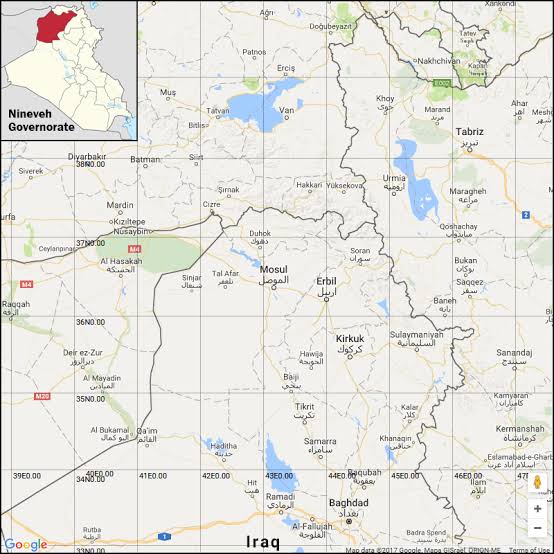
Bevara/Al Buwarah salt deposit is on the Iraq-Syria border,
due south of Nusaybin, on the Turkish border, and east
of Deir ez Zor and Mayadin (left side of map in Syria).

Lacus Beberatisi's location, in other words Bevara salt deposit's
location, is directly south of Nusaybin.  To the northeast is Sinjar
Mountain.  Hatıra, otherwise known as Elhatıra, is mistakenly shown
on Butiniger's map as being located southeast of Lacus Beberatisi.
But the Elhatıra ruins are situated northeast of the Bevara salt deposit.
Bevara (Al Bawarah) and Lacus Beberatisi are one and the same. The
Saba salt deposit had previously been unknown.  It was discovered
six months after Bevara was taken into the Düyun-u Umumiye account
(State public debt commission, whose purview included the sale of salt
to pay off Ottoman state debt). Saba is 9 hours southeast of Bevara and
the salt deposit/swamp called Kiyabe, on the banks of the Euphrates
River, is 4 hours to its west (Logutatidis). There is no complete depiction
of Saba.

(1) Miller. a.a.o., s. 113.
ninevah map 800 bc ile ilgili görsel sonucu"
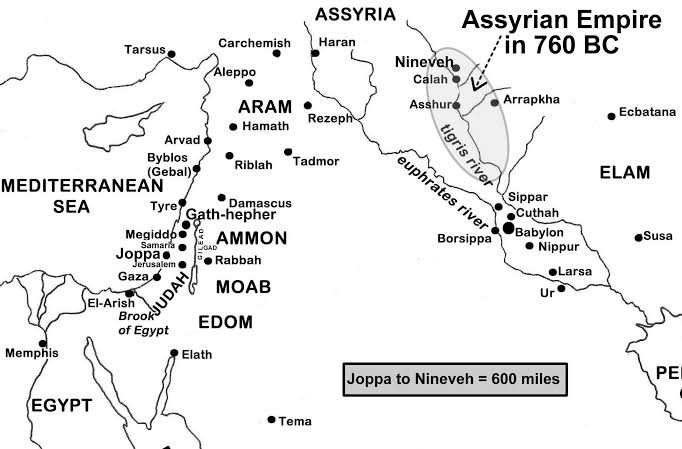
Map shows the Assyrian Empire shortly after the time of King 
Adednirari III.

Along the ancient road that goes from Bevara to Saba, an Assyrian
'stela' (an upright stone or column with an inscription) was found and
some helpful information has been obtained from it.  The 'stela' was in
two pieces when it was found in 1905 near Saba on the slope of a sand
dune and it has a raised inscription on it, which relates to Assyrian King
Adadnirari III.   King Adadnirari ruled from 811 to 783 B.C. and the
inscription pays fealty to gods whose likenesses and symbols are depicted. 
This inscription was mentioned in the number 2 publication of the Müze-i
Hümayun in 1916.  (1)

The historic inscription relates that because King Adadnirari was quite
young when he took the throne he could not administer his duties so his
mother Semiramis's son assumed these duties for five years in his stead.
The name of the place where the 'stela' was situated was written on the
inscription as "Zabanni".  If we compare this name with Saba then it
can be likened to Saba's ancient name Shaba, which is the same as that
of a tribe that lived to the northwest of Rava in Assyrian times -
consistent with the 9th century B.C. when the King lived. 

(1) “Publikationen der Kais. Osmanischen Museen", Heft II.


9 November 1916                Doctor Unger, History Teacher


//END of PART III/FINAL//


(