25 Ekim 2019 Cuma

TV Crocodile Tears for 'Missing' Wife He'd Torched


türkçe links to original Turkish article

(Milliyet Newspaper, 24 October 2019)

osman yalçınkaya müge anlı ile ilgili görsel sonucu
Osman Bey's budding TV career just sort of 
flamed out.

On 10 June in Kocasinan district of Kayseri province, Osman
Yalçınkaya (59) went to the police station, saying that his wife Fatma
Birgül Yalçınkaya (51), the mother of their 3 children and an Alzheimer
sufferer, had gone missing.  Subsequent searches by the Yalçınkaya
family and the police proved fruitless. A tearful Osman bey even went
on a TV program to plead with the public for information about the
missing Fatma hanım (!).

However (!), on 28 July some citizens found bones in an area of
abandoned buildings and DNA tests on the bones revealed that they
were those of Fatma hanım.  Police established a special team to
investigate the case and learned that Osman bey had a drinking
problem and fought constantly with his family members. He was
taken into custody and confessed to burning his wife to death.

In his statement to police, Osman bey explained that "it was the
month of Ramazan.  I took her to the place where the abandoned
buildings are.  There, I knocked her out and put paper and wood
chips on top of her.  I lit a fire with my lighter.  I waited quite a
while as she burned.  Then I went home and broke my fast. I told
my children and my neighbors that my wife had disappeared.
Together with the police we searched for her all that night." (!)


kocasinan kayseri haritası ile ilgili görsel sonucu


23 Ekim 2019 Çarşamba

Instagram 'Come Hither' Pose Causes Trouble


türkçe links to original Turkish article

(Milliyet Newspaper, 23 October 2019)

atletli poz davasında ali uğur akbaş ile ilgili görsel sonucu

"Good morning Darling. Isn't it a beautiful day? 
How about we make love some more before 
breakfast?" (what woman could say no??!!)

The posting on Instagram of a picture of Ali Uğur Akbaş, a businessman
who is the husband of actress Yeliz Yeşilmen, has created a controversy.
The photo shows Akbaş wearing a t-shirt and  having breakfast in bed.
When producer Bilal Özbilge showed the picture on the TV show
"Söylemezsem Olmaz" (If I Don't Say So, Nothing Happens) Akbaş
allegedly phoned Özbilge and flung insults and threats at him.

Özbilge filed a criminal complaint against Akbaş asking for a jail
term of up to 4 years.  For his part, Akbaş claimed that the voice on
the threatening phone call was not his.  At the court hearing of the
case, Özbilge appeared but Akbaş was a no-show.  Özbilge's lawyer
Levent Karakoç stated that summonses sent to all of Akbaş's known
addresses were returned unanswered. The court ordered that Akbaş
be arrested and brought to court.
İlgili resim
  After breakfast, none the worse for wear...

22 Ekim 2019 Salı

TNT History Archives: Lamenting the Dearth of Turks' Turkish Names (1906)/Part II/FINAL


//Ed. Note: In continuation of his commentary on 
espousing Turkish names for Turks, rather than 
Arab or Jewish ones, Şerefeddin Mağmumi even
provides some candidate names.

Mağmumi himself was born Eşref Fevzi. It is 
said that he adopted the name "mağmumi",
which means "sadness", as a consequence 
of his mother dying when he was very young.//


                            Mağmumi in 1895.

In those times (Ottoman period) Turkishness was looked down 
upon and they chose the wrong way by favoring Arab style! As
was the case in the West (Ottoman Turkey), so too in the East, 
meaning Khiva, Buhara and Kashgar, Arab names were mostly
used.  Today in Anatolia only a few Turkish names like Yaşar,
Durmuş, Bayram and Tosun remain. Half of the men are named
Ahmet, Mehmet, Ali, Hasan and Hüseyin and there are many
families with generations of men - fathers, grandfathers, great
grandfathers - named Mehmet.  As for women's names, they 
are seemingly limited to Ayşe and Fatma.   

In the big cities, and especially in Istanbul, there is a gradual 
return to "Turkishness-light".  But rather than reviving our own
lost names, odd ones like Nejad and Nevzad have begun to be
adopted.  In my view, just as every nation has its own unique
language, there are also names that accord with that language's
accent and pronunciation.  A person should bear a name that
can be pronounced in his own language, regardless of religion
or sect. When a Christian, be he a Greek, an Armenian
or an Englishman, accepts Islam, he doesn't abandon his own
language for Arabic and neither is it a requirement that he take
an Arab name. He still speaks his own language and goes by
his own name.

Nevertheless, a convert to Islam may feel the need to have the
name of the Prophet Muhammed or one of his disciples in
tandem with his own name.  For example, William from 
Liverpool may become "Abdullah William", Bob from America
may become "Mehmet Bob" and Noda from Japan may become
"Abdülhalim Noda" when they convert to Islam.  So why can't
we Turks add a Turkish name to our Arab one?

panturkism map ile ilgili görsel sonucu

Some Turks might say that they don't know of any Turkish names
but Necip Asım gives 20-30 candidate names in his book
"Turkish History".  If these don't suffice then our children can
search for more and multiply the candidate names as time goes
by.  Some may say that these names sound strange but this is just
a matter of  training the ear to accommodate new sounds, like
getting used to anything else that's new.  We get used to things
with repetition and the strangeness gradually disappears. Already,
names like Orhan and Tarhan don't sound odd anymore because
our ears have become attuned to them.

We should start to use other Turkish names, too.  Why not have
"Aydın", "Gündüz" and "Aygil" instead of  "Münevver", "Enver"
and "Lâmi"?   And "Yaşar", "Durmuş" and "Doğmuş" in place of
"Hayati", "Baki" and "Tevzad"?  You say you want some more
candidate names, well here are a few from "Turkish History": for
men - Oğuz, Kalkız, Uluğ, Turgut, Bayktal, Macur, Satık, Buğra, 
Teskeş, Tetiş, Argun, Ayaz, Çağrı, Gümüştekin, Kavrid, Savcı, Alp, 
Şadu, Erkil, Tulun and, for women - Türkan, Alan, Sevgül, Saraya, 
Baykan, Saygül and Gökcel.

So both myself and a few of my fellow writers deem it necessary to
adopt pennames, like "Oğuz", in order to get our readers accustomed
to these "esami-yi Etrâk" (Turkish names) out of patriotism for our
nation.

//Ed. Note: herewith a list of pure Turkish names 
that are very common among men in Turkey today, 
whereas in 1906 probably none of them were in 
use.//
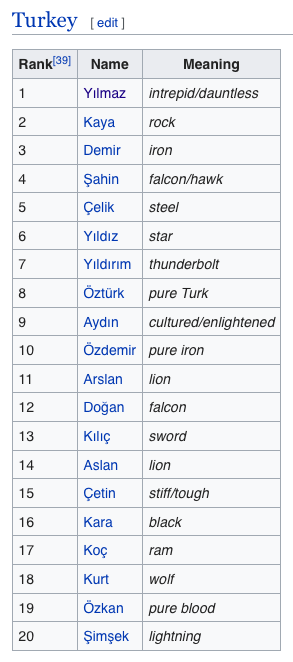
Top 20 Turkish Surnames


.


TNT History Archives: Lamenting the Dearth of Turks' Turkish Names (1906)/Part I


//Ed. Note: Atatürk, in particular, revived awareness
of the Turks' Central Asian history and Turkish 
names for men and women have increased since 
his time. 

But as Şerefeddin Mağmumi pointed out in the
newspaper column he wrote in Cairo in October 
1906, Turkish names and the Turks' Central Asian 
origins had been neglected during Ottoman times.//

 atatürk türklüğü ile ilgili görsel sonucu

I'm Thinking That...
"Türk" newspaper: 2 October 1906

Our Ottoman forebears forgot our own national names and 
took Arab and Jewish names instead.  In fact, they nearly lost 
our language and bid farewell to Turkishness.  Thankfully, due 
to the work and efforts of a few patriots, our language has been 
rescued from this fate.  In a short time, by means of an
amazingly progressive work, equalibrium was restored.  But
we are, nevertheless, still trying to prevent our own names
from being throw in the ditch of oblivion. 

oğuz han ile ilgili görsel sonucu

In this regard, though, as yet momentum is still lacking.  Some 
of our readers are asking me in writing, and most of them 
verbally, what is meant by the penname "Oğuz" that I've 
adopted.  Many of them think that it's a typo, in that the 'z' at 
the end should actually be 'r', forming the word 'uğur' 
(auspiciousness). 

The fact that Oğuz Khan was a very famous Turkish ruler has 
been lost within our historical records.  In any case, the weakest
link in our knowledge of our history is awareness of our own
nation, our origins and the Turks in general.  The history books
in our schools begin with "Sultan Osman", with passing
mention of his grandfather Süleyman Shah's movement to the 
east.  That's about it.  Prior to that it's all darkness. There is 
nothing written or taught about our origins in Turkistan six
centuries ago, just a few pages about the Mongols and the 
Turks of those times. 

Fortunately, a few years ago an industrious and patriotic man 
named Necip Asım succeeded in writing a detailed Turkish 
history, starting from our origins.  But what a strange country
and goverment we have: rather than honoring the writer who
rectified this shortcoming and putting his book in the schools,
the Ministry of Education has withheld permission for a second
printing of the work.  The reason is quite a puzzle and a hidden 
secret.    

necip asım ile ilgili görsel sonucu

In any event, our topic is Turkish names so let's return to that
matter.  Just as the Turks, a separate nation of 25-30 million
people, have their own language, certainly there are hundreds
of Turkish names for men and women, as well.  In Central Asia,
no one was named with Arab and Jewish names like Ahmet, 
Hasan, Yusuf and Musa.  It was only after the acceptance of 
Islam that they gradually began to adopt Arab names, based on
religion.  The Selçuks took Turkish names and added a second
Arab name.  Then, the members of the tribe of Süleyman Shah,
who was the grandfather of Sultan Osman, adopted Turkish 
names like Ertuğrul, Orhan, Durmuş, Gündoğdu, Aydın and 
Alparslan.

However, following the establishment of the Ottoman sultanate,
these national names gradually disappeared to the point that they
were rarely heard again.  It is worth noting that there was not a 
second Sultan named Orhon, nor was the name Ertuğrul or any
of the other Turkish name given to any of the subsequent
Ottoman sultans' children.    


joseph de guignes hüseyin cahit yalçın ile ilgili görsel sonucu

//Ed. Note: The French scholar Joseph de Guignes 
wrote a comprehensive history of the Turks in 1750 
but it wasn't until 173 years later that Hüseyin 
Cahit Yalçin, at the urging of Ziya Gökalp, 
translated de Guignes's work into Turkish in 1923-
1925.//

//END of PART ONE//


21 Ekim 2019 Pazartesi

Cambodian Rendition by Way of Mexico

 Türkçe links to original Turkish article

(Sözcü Newspaper, 21 October 2019)

mongolian rendition click here for a TNT report
about a Turkish rendition operation in Mongolia
in the summer of 2018.

mongolian rendition stymied click here for a
TNT report about the same rendition, gone bad.


fetö'nün meksika imamı kamboçya'da yakalandı ile ilgili görsel sonucu
                         He'll be missed in Phnom Penh.

Osman Karaca, the 'imam' (religious representative) in Mexico
of the Fetullah Gülen Terror Organization (FETÖ), accused by
Turkey of fomenting the failed coup in July 2016, has been
captured by the Turkish National Intelligence Organization
(TNIO) in Phnom Penh, Cambodia. (!)

TNIO, which has successfully snagged FETÖ members in
Kazakhstan, Azerbaijan, Kosova, Indonesia, Malaysia and
Pakistan (but not in Mongolia - see refs above), had local
Cambodian police help in capturing Karaca, who is a
Mexican citizen, at a bank in the capital Phnom Penh on
14 October.

Karaca's wife Garace Lalrinmawi is a Cambodian citizen and
after the failed coup in July 2016 Karaca started living in
Phnom Penh.  He has been bundled back to Turkey by TNIO.


cambodia turkey map ile ilgili görsel sonucu