29 Mart 2020 Pazar

TNT History Archives: Ottoman Army's Retreat From Palestine (1918)/Part VII

//Ed. note: Major Vecihi presents some observations and
opinions about army life in general and harkens back to
the Ottoman attack on the Suez Canal in 1915.//
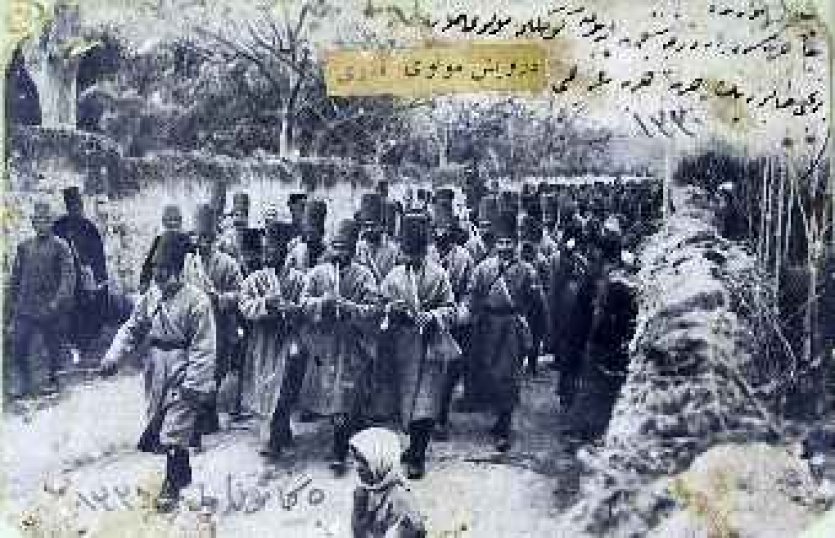
Armenian on web :: Dardanel-Çanakkale Harbinde Yahudiler Hem ...


It cannot be denied that during the most difficult times, as at Sahra-ı
Tepe when we were being tossed around and then finally alongside
the (Suez) Canal, meals and every other aspect of army life were in
better order than during the time in Palestine.  You might say "even
though meals may not have been orderly in Palestine, at least there
was hot soup. Much better than the dry bisquits at the Canal." 

True, at Sahra-ı Tepe there was nothing to eat other than dry bisquits
and a few dates, washed down with lukewarm water.  But everyone,
from the top commander to the privates ate the same way.  It was
collective misery.  The relationships between officers and soldiers there
was nearly brotherly, it was so tender and sincere.  The best way to
ensure compassion, respect and obedience is to create felicity.

So by transferring this family-like atmosphere to the army mess during
times of calamity and deprivation, all of these virtues are increased and
soldiers' willingness to make the requisite sacrifices multiplies, as well. 
In order to understand this ferver, one need only look at the astonishing
strength the army displayed when soldiers were sunk in the sand up to
there knees, hungry and thirsty, on their way to the Canal.

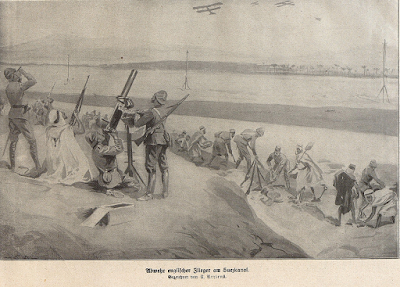
Advance by the Turks on the Suez Canal, 1915 | Map Great War ...
Ottoman attack on the Suez Canal, 1915.

How about the food situation in the final days in Palestine?  Meat, rice,
baklava, börek - everything was available.  But not for everyone in the
same degree.  While some at the front filled their stomachs with boiled
wheat or flour soup, others enjoyed steak and sweets and drank iced
'hoşaf'. And it wasn't just the Germans who ate well.  Some of our
fellows did, too. 


There were some detachments that fed their troops well and paid them
in gold and silver, but there were others that had a hard time finding 
even flour soup for their soldiers and paid them with paper money 
that was essentially worthless in Arabia.  Yet, they were all soldiers
fighting for the same cause and enduring the same deprivations. Some
were relatively happy with lots of good food and other were in the 
complete opposite situation.  

If one needs to look for the reasons for defeat and weakness, look no 
further.  The sadness and despair that such unseemly inequalities 
engender diminish the orderliness, obedience and respect that are the
essential elements of an army, and hunger devastates a soldier.

//END of PART VII//


TNT History Archives: Ottoman Army's Retreat From Palestine (1918)/Part VI

//Ed. note:  At this point in his story, Major Vecihi relates
a few interesting anecdotes about a variety of subjects.

One gets the impression that he came to the YAG from
the Galicia front in Romania, although he doesn't 
explicitly say so.//

Hicaz demiryolu haritası | Haritalar, Harita, Tarih

The transport capacity of the Hicaz Railway links between Damascus
and Amman and between Der'a and Tafile was so limited that even
one day's provisions for the army could not be transported.  An army
corps at Homs that belonged to the 2nd Army, which was at Aleppo,
came from Galicia and its divisions were immediately included in the
Yıldırım Army Group (YAG). 

The 43rd Division at Cebel-i Lübnan (Mount Lebanon), previously at
the HQS at Aleppo and then at Homs, was combined with a detachment
of a few hundred soldiers at Tedmür and put under the command of the
army corps that came from Galicia.  The 43rd Division was assigned to
guard the Mediterranean shore together with a few local Gendarmerie
battalions and a Mevlevi regiment with two battalions. 


                                  The Mevlevi Regiment

But the 'Mevlevi regiment' was that in name only, since there were no
descendants of the grandfathers that once comprised it.  There was,
though, a volunteer group from the Mevlevi regiment at Damascus but
they weren't fighters. Rather, it was an entertainment group.  When I
was in Damascus I went to a few dinners where I listened to the
harmonies these elderly fellows played on their flutes and lutes.

There was also an army corps of the 2nd Army stationed at Adana.  It
was manned much like the 15th Army Corps at Homs and its duty was
to guard the Mediterranean shoreline from Side to Mersin, with never
more than 5-6,000 troops. 


With regard to meals for such a weakened army, the situation was quite
dismal.  Although, when the troops on this front were commanded by 
Turks (as opposed to Germans?) they were better off.  In every matter,
from meals to health to whatever, there was a different structure and 
approach.  For example, when under pressure during the Battle of Gaza,
telegrams could be sent to the commanders, governors and other 
officials at Aleppo, Damascus and Adana, with a response coming back
in 24 hours and the needed soldiers, ammunition, grain, flour, sandbags,
etc. procured. 

Equally odd, the trains couldn't maintain a set schedule because they
were fueled with wood.  So army commanders would somehow,
seemingly by magic, have to get the engineers and train crews to 
deliver soldiers and ammunition to a particular place at a particular 
time.  How could the commanders do this? Because they had a sixth
sense of sorts, enabling them to calculate how many troops they could
get from a particular detachment, what kind of grain they could get 
from a particular depot, how many sacks and bags they could get from 
a province or a district.  

These commanders knew how to address someone, based on that 
person's aptitude, and the commander's word was the law. Punishment
was administered harshly. No one had the luxury of inaction or delayed
reaction.  I don't know about the public at large, but in the army, and 
especially during war, this type of discipline is appropriate.  

However, during the retreat from Sinai to Palestine, when administration 
was turned over to the Germans, the order within the army broke down.

SRL17212b 100th anniversary of the first battle of Gaza (Friedrich ...
General Friedrich Kress von Kressenstein was the
commander of Ottoman forces in the Sinai Desert.


//END of PART VI//

28 Mart 2020 Cumartesi

TNT Coronavirus Edition: Closed "Hamam" Becomes "Casino"


türkçe links to original Turkish article

(Sözcü Newspaper, 28 March 2020)

Kovid-19 tedbiri için kapatılan hamamda kumar oynarken ...
          Police to M.G.: "Hey, you gambled and you lost."

Because of the coronavirus outbreak, many businesses and shops have
been closed throughout Turkey.  In Tarsus district of Mersin province,
A.S., the owner of a 'hamam' (public bath), closed up and went to
Ankara.

However (!), one of his workers, M.G., took advantage of A.S.'s
absence to turn the hamam into a gambling hall.  The Tarsus police,
though, got a tip and raided the 'casino' the day before yesterday,
catching 10 gamblers in action.  Each of them was fined 4,767 TL
(about $850).  As for M.G., he was arrested for "establishing a
gambling venue".

Where is Tarsus, Turkey? / Tarsus, Mersin Map - WorldAtlas.com


TNT History Archives: Ottoman Army's Retreat From Palestine (1918)/Part V

//Ed. note: Major Vecihi gives a blunt assessment of the
Ottoman forces in Palestine in the aftermath of the fall
of Jerusalem to the British.//

Battle of Jerusalem - Wikipedia

Status of the Army

Let me give the status situation:  after the fall of Jerusalem it would
have been impossible for our army not to realize the end result of
trying to defend this vast, stubborn battlefront.  Forget about launching
an assault, the army had no strength left for its own self-defense, as
the troop numbers dwindled.  Urgent efforts were made to draft
recruits through the local military bureaus, but not more than a few
young and old men were available because the well of reserves had
long since run dry.

After waiting many months, a few hundred soldiers were sent in,
having been recruited with great difficulty in the name of the Yıldırım
Army Group (YAG).  But these weren't hearty soldiers under arms.
Rather, they were hospital dischargees and deserters rounded up from
here and there.  Essentially, those fighting on the front line were only
Turks from Anatolia.

Since the Arab soldiers weren't trustworthy, they served in the rear,
at the way-stations and in the stores depots.  Most of the Arabs didn't
like us and some of them helped the enemy openly and others secretly.
So we were trying to defend Arabia against both the enemy and the
Arabs themselves.

The army's losses could not be refilled and the ranks were diminishing
further each day.  A 2,000-strong division dwindled to near nothing. A
normal division would have between 1,000-1,500 soldiers but these
divisions shrunk to battalion or even regimental size.  Consequently, the
divisions were unable to perform the duties assigned for an original
force of 10,000 armed soldiers.  The number of soldiers, officers, gear,
ammunition - in other words, everything had changed for the worse.

New exhibit showcases 1917 British invasion of Palestine

So only the names of the divisions remained in tact, the same as they
had always been called in the Ottoman Army, but with one tenth the
strength.  Why weren't these weakened divisions combined into one
relatively stronger unit?  In that way, it would have been much more
efficient and easier to take care of the army.  Why wasn't it done?
There is no need to scratch your head, the reason was clear.

At first blush, the YAG's army corps and divisions seemed well-stocked
with troops but in reality they were quite weak.  There were 25-30,000
men under arms and, of course, the rear support soldiers were not part
of this number.  If they were included, the number of YAG troops
amounted to about 100,000.  In any event, these forces were spread
along the front from the Mediterranean Sea to Medina.

As I have said, divisions that rarely had 1,000 troops were defending
portions of the front 5-10 kilometers long.  So you can get an idea of the
reality facing our entire 100,000-strong army, with proportional war
material and equipment, as it tried to resist a large and well-outfitted
enemy army.

And there was no reserve forces of ours in the immediate rear, which
every army or army corps would normally have.  There was an army
HQS at Aleppo with two army corps but this force was unable to come
to the aid of the YAG when needed - the two armies were so far apart
that it would take at least two months for relief forces to arrive overland.

//END of PART V//   


27 Mart 2020 Cuma

TNT Coronavirus Edition: One Less Health Worker Available


türkçe links to original Turkish article

(Hürriyet Newspaper, 27 March 2020)

Sağlık memuru kadın isyan etti! 'Öldürülmekten korkuyorum' - Son ...
         "All Hands on Deck!" (well, maybe after a while.)

Buket S. (23), a health worker at the Gaziantep Oral Health Hospital,
began living with her father-in-law Mahmut S. after her husband of
5 years went to prison 9 months ago on narcotics charges.  Having
decided to seek a divorce from her husband, Buket S. applied for a
transfer to Antalya and received approval.

However (!), her father-in-law objected to Buket hanım's transfer to
another city and stabbed her six times in front of the house on 19
February.  After the attack, the young women stayed in intensive care
for 4 days and Mahmut S. was taken into custody.

Since being released from the hospital, Buket hanım has moved to
Antalya with her two sons.  She plans to formally file for divorce
from her husband once she fully recovers. Buket hanım explained
that "I fear for my life right now and want protection for myself and
my children.  Those who put me in this condition must be punished."

Gaziantep Antalya Sahilden arası mesafe, Gaziantep Antalya ...


TNT History Archives: Ottoman Army's Retreat From Palestine (1918)/Part IV

//Ed. note:  Setting the stage for the Ottoman Army's retreat
from Palestine, Major Vecihi first describes the Ottoman 
front line there in the winter of 1917-1918 and then the 
rationale behind the formation of the Yıldırım Army Group
(YAG).// 

Suriye – Filistin Cephesi – scientificrevolutionligthnings

Overall Situation Prior to the Retreat

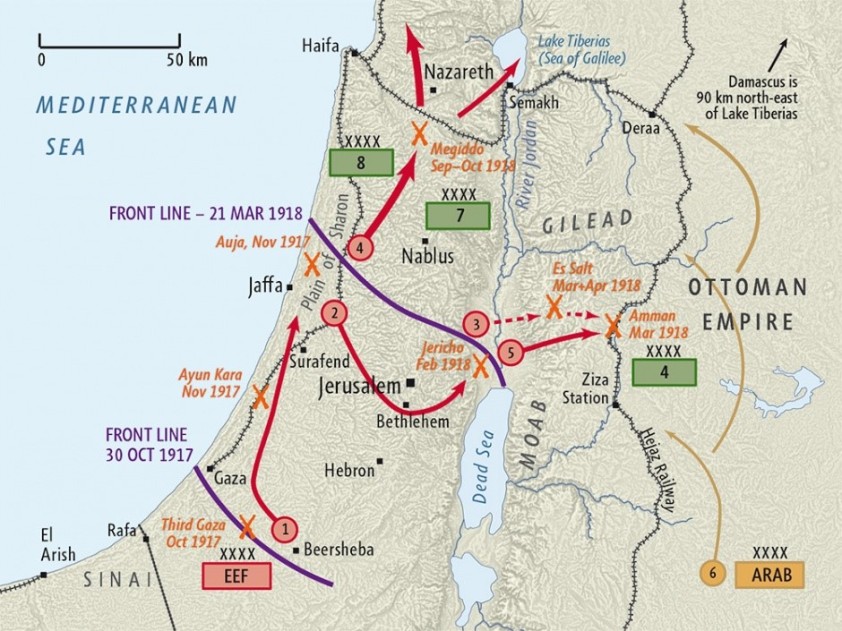
After the fall of Jerusalem (9 December 1917), the battlefront
expanded disproportionately vis-a-vis our existing forces.  Our front
stretched from Medina to the north, following the Hicaz railway line,
crossing south of the villages of  Salat and Nablus and from there to
the south of Haifa on the coast of the Mediterranean Sea.  The 7th and
8th Armies were on the west side of the Şeria (Jordon) River, which is
linked to Bahr-i Lut (The Dead Sea) and Lake Taberiye (Sea of
Galilee), while the 4th Army and the Medine Defense Force were on
the east side of the river.

These three armies comprised the Yıldırım Army Group (YAG), under
the command of  General Liman von Sanders (as of 24 February 1918.
He was preceded by General Erich von Falkenhayn) and with its HQS
at Nasiriye (which fell to the British on 27 December 1917).  The
divisions of the YGA had fought on many fronts of the Great War, not
just the one in Arabia.  In this fourth year of the War, the clashes
underway in Arz-ı Kenan (Canaan) were the final phase of a
travail that had dragged the soldiers from the snowy Balkans and
elsewhere to these burning hot valleys in an unbearable series of
deployments that mankind had never witnessed before.


Birleşik Harekat Tecrübesi Olarak Cihan Harbinde Türk-Alman Askeri ...

The fact that the Turks agreed to fight in places far from one another
and with dispersed forces, facilitated the easy enemy occupation of the
regions within our vast nation.  Our army, fighting with less than a
million guns on four or five fronts, hundreds and thousands of
kilometers from each other at the same time, could resist none of  the
enemy attacks, save for Çanakkale.

//Ed. note: Actually, the Ottoman 'Islamic Army of the Caucasus'
scored a resounding victory in Dagestan in the Fall of 1918, but it
was all but negated and forgotten because of the humilating 
conclusion of The Great War for the Ottoman Empire at the end of 
October 1918.

Islamic Army of the Caucasus click here for the first in a multi-
part TNT series from November-December 2018.//

Baghdad was lost, the Russians had entered Erzurum, Erzincan and
Trabzon, the English came as far as Gaza, seized Jerusalam and then
threatened Syria.  So, since the English occupation of Syria would
put Iraq and the Caucasus in jeopardy, as if we had finally come to
our senses, a portion our troops were recalled from Iraq, Iran, the
Caucasus, Romania, Macedonia and Galicia. 

After long and difficult marches from these various fronts, reminiscent
of the 'Retreat of the 10,000' in 400 BC, these troops assembled at
Aleppo under the name YAG, with the intention of retaking Baghdad.
However, the cry for help from our forces on the Gaza front quickly
diverted the YAG to Palestine instead, setting the stage for this last
calamity in the preordained destiny of the Ottoman Empire.

Retreat of the 10,000 Anabasis click here for a TNT report on this
legend from October 2017.


//END of PART IV//

TNT Coronavirus Edition: Istanbul Burials - NIMBY!* & Turk Villages in Greece Quarantined


türkçe links to original Turkish article

(Milliyet Newspaper, 27 March 2020)

* Not In My Backyard

Beykoz'da "korona virüs mezarlığı" tartışması
                              Backhoes in the backyard.

With regard to the coronavirus outbreak, based on the recommendations
of the Science Council and Religious Affairs Ministry, two burial sites
were identified for Istanbul on the European and Anatolian sides of the
city, at Kilyos and Beykoz, respectively. 

Victims of the illness have begun to be buried at the Baklaca Cemetery
near the Çavuşbaşı Baklacı neighborhood in Beykoz.  However, local
residents have objected, as explained by Abdurrahman Öz: "the Istanbul
municipality had designated Çavuşbaşı as a burial site but this is a
residential area, with schools.  The cemetery is right on the other side
of the main street.  Why would you bury people in a neighborhood?!
If there wasn't a danger they wouldn't bury these people here."

Police had to be called to the cemetery to disperse an angry crowd of
local residents and then took up guard positions at the entrance, while
backhoes worked in the rear, wooded area of the cemetery.

Ulaşım « Boğaziçi Simas Konakları
Kilyos, at top, on Istanbul's European side and Beykoz, at 
right, on the Anatolian side.

------------------------------------------------------------------------------

türkçe links to original Turkish article

(Sözcü Newspaper, 27 March 2020)

Yunanistan'da Türk köyü karantinaya alındı - Deniz Haber-Kaptan ...
                               Looks idyllic, doesn't it?

Coronavirus panic is sweeping through the area of Greece around
İskeçe (Xanthi) in western Thrace, where Turks are concentrated. 
The Turkish villages of Miki and Şahin in the Mustafçova region have
been put under quarantine after 4 cases of the illness were identified.

A 77-year-old male in Miki village has died.  The coronavirus
incidents are said to have occurred after local residents working in
Europe returned from there to their home villages.  Residents have
been ordered to stay at home for 14 days and medicine and food
are being distributed to their homes.

Xanthi
                                        Xanthi (İskeçe)