2 Temmuz 2019 Salı

Sinop Fortress Besieged by Concrete Time-Lapse Catapults


türkçe links to original Turkish article

(Hürriyet Newspaper, 2 July 2019)

Kaskians click here for background on this mysterious
group of people who were at odds with the Hittites.

pedestrian-friendly Sinop see this TNT report about
Sinop's enlightened ways vis-a-vis pedestrians.

sinop kalesi kalekondu ile ilgili görsel sonucu

 Sort of like man-made ivy that insidiously invades historic
fortress walls - let's call the 'kalekondu' a time-lapse catapult.

The encroachment of modern buildings on and around the walls of the
historic Sinop Fortress-Prison is a cause for concern.  The fortress was
built by the Kaskians 2,500 years ago and is on UNESCO's temporary
heritage list. 

Using the fortress's walls for foundations, people began to build
houses and buildings within the 12-meter fortress-preservation area
around 1982. There have been many efforts to have the 16 houses
built within the fortress, adjacent to it or right next to it razed but
so far without success.  Consequently, these "kalekondu" houses
(the upscale version of the low-end 'gecekondu' houses put up
illegally overnight) remain and their owners have even added PVC
windows and French balconies. 

sinop cezaevi ile ilgili görsel sonucu
The historic Sinop fortress-prison is in the foreground.

Tourism official Ali Yılmaz lamented that "these buildings are quite
ugly and wrong.  Sinop is a fortress city and we in the tourism industry
want the area around the fortress to be completely open.  The old Sinop
Prison within the fortress is a big tourist draw but these illegal buidings
are endangering the structure of the fortress and it may collapse in a
few years."

rumeli hisari evler 1930 ile ilgili görsel sonucu
Not so long ago there were houses and homes within the walls
of Rumeli Hisarı on the Bosphorus in Istanbul.

Echoing Yılmaz, Hale Oğuz, the chief of the Sinop Friends of the
Environment Association, stated that "Sinop is well-complemented
by the fortress so its perifery should be open and nothing should be
built within its preservation area.  But the fortress has been subjected
to these 'kalekondus', which are built at the expense of the fortress's
walls.  It's essentially a murder of history. Really horrible.  Without
penalizing the 'kalekondu' residents and by paying them the market
rate, the buildings should be torn down and the fortress's perifery
kept open. We're hopefully expecting that this will happen."
(Ed. note: don't hold your breath Hale hanım.)

sinop turkey map ile ilgili görsel sonucu
                                       Sinop (red dot)


TNT History Archives: American Scolds Britain's Islam Policy (1921)/Part III-A

//Ed. Note: In his continuing diatribe against Britain's 
polcies toward Islam, this unnamed American takes aim
at England in India. TNT has split this India portion into
two parts.//

british india ile ilgili görsel sonucu
                                             1914 Map


Atrocities in India
The former chief of the American Cabinet, Mr. William Jenks
(ed.note: name as transcribed from Ottoman Turkish), made 
these notes about English atrocities in India in his travel log:

“Above the door of the courthouse in Elbagir in India, there is 
a sign which reads 'The Pillar of the English Government is 
Justice'".  When I read this I was reminded of Jenks’s words: 
“Even if you praise your courts up to the sky, as long as basic 
justice is not administered then the slap of a woman will bring 
them down.”  

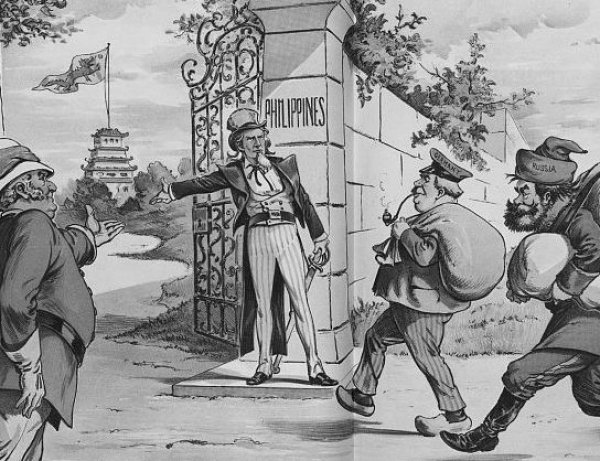
"After the American government seized Manila it decided to 
follow a colonial policy.  In this regard, it seemed to me to be 
worthwhile to examine England’s method of administration in 
India because England’s colonial policy is held in high esteem 
throughout America.  So I got in contact with a number of 
high-ranking English civil servants.  I also met with educated 
Indian Hindus, Moslems and Parsis.  I looked into the lives of 
both the wealthy and the poor, relevant statistics and various 
speeches and reports that I could never find in America.  As a 
result, I came to the conclusion that the English 
administration in India is more oppresive than I had previously 
thought."

 american philippines ile ilgili görsel sonucu
                                              
Lordly Administrators
Another article in the aforementioned Mr. William Jenks’s 
travel log caught my attention:  “I met with Lord Minto , as 
well as with the Bengal and Bombay governors.  England 
acquired India for its own interests, not for those of the Indians. 
Of course, the laws and the administration are intended for the 
benefit of the English and certainly every matter is adjudicated 
as if the judge was deciding on his own personal case.  All of 
the civil servants in India are English. The central government 
there represents the English nation, not the Indian nation.   
These civil servants come and go to and from England for 
specific periods and they look at all matters from an English 
perspective rather than from an Indian one.  Of course, they are 
not as knowledgeable about the needs of the populace as are 
those who deal with the people each day are."

Even the English Condemn England
During the war in South Africa, it was the English themselves 
who criticized England most vociferously for the oppression 
inflicted on the Moslems there.  Today, there are many in 
England who are critical of the English administration in India.
 
An Indian named Nayirobi (ed. note: as transcribed from 
Ottoman Turkish) went to England and had a 3-paragraph letter 
he prepared accepted by one of the free-choice societies there 
about the oppression that the Indians are suffering.  Here are the 
three paragraphs:


"England unjustly occupied India in order to have an endless 
treasure for itself. It is administering a sultanate there with 
billions spent from India’s national wealth." 


"Every year England steals 30 million sterling from India’s 
national wealth.  For this reason a great portion of the people 
are poor and needy.  England has a debt to address the causes 
and find solutions for the misery that drought and famine 
cause and must make the necessary related expenditures."

"Is it becoming to England that donations have to be sought 
from other nations to fill the stomachs and treat the illnesses 
of Indian citizens enslaved under a 150-year administration 
that cast a stain on Englishness?"


 british india cartoons ile ilgili görsel sonucu

Official Duping and False Promises
Again, the aforementioned William Jenks stated that: “Queen 
Victoria issued a statement in the aftermath of the Indian 
uprising of 1857, to the effect that Indians of honor and with 
education would be appointed to civil service positions with 
an eye toward independence.  But Lord Lytton, a viceroy in 
India, stated this in his recently-published confidential notes 
with regard to this matter, in particular, that:  ‘We all know that 
this request and hope of the Indians will never come to pass.  
We would never accept the Indians into the regular civil service.  
We would choose the less-qualified second-place candidate by 
duping and distracting the Indian candidate.'"  

"In another note, Lord Lytton wrote that ‘Here in this 
confidential note that I write, I have no hesitation in confessing 
that the English and Indian governments did not stand by their 
promises and they have still not be absolved of this stain.’" !?

Despotism
The people of India have no say with regard to the taxes they 
pay and the expenditure of this tax revenue.  Out of $250 
million collected annually (56,500,000 Ottoman liras) in taxes 
some $100 million (33,500,000 Ottoman liras) are spent on the 
Indian army but an Indian cannot be an officer in this army.  A 
total of $100 million (33,500,000 Ottoman liras), which is the 
equivalent of the general expenses of the Indian government,  
is sent to England each year  and this is about half of the 
general tax revenue collected.  Another $15 million 
(3,400,000 Ottoman liras) is allocated for foreign officials in 
India.  One wonders what other nation on Earth could bear this 
kind of a loss of its national wealth?

//END of PART III-A//

1 Temmuz 2019 Pazartesi

Late Brothel Madam's Riches in Dispute


türkçe links to original Turkish article

(Hürriyet Newspaper, 1 July 2019)


bir dava da doradan matit manukyan ile ilgili görsel sonucu
             Straight out of central casting.

The famous brothel madame Matilt Manukyan, once so wealthy that
she was a record-breaking taxpayer (!), died in 2001 and left
everything to her son Kerope Çilingir (79).  However, 36 people filed
suit against Çilinger to get a portion of the inheritance and now his
own daughter, Dora Çilingir, has filed a suit against him in order to
become the exector of her grandmother's estate.

The court decided to freeze Manukyan's wealth and, at the same time,
an investigation was started into Çilinger for official document fraud.
Two weeks ago, his daughter Dora fıled suit in Istanbul court to be
named her father's heir, stating in her petition that "Kerope Çilingir
disappeared because of deadly threats.  For a long time he lived in
hotels to avoid being found.  Lately, Kerope Çilinger was discovered
nearly dead in a hotel room and was brought to a private hospital
for treatment.  Hospital officials stated that when he came to the
hospital Çilinger was unwashed, undernourished and essentially a
homeless person."

In response to Dora Çilingir's petition, the court decided to put a
temporary hold on all real estate registered under Kerope Çilingir's
name.

the best little whorehouse in texas ile ilgili görsel sonucu
                          Inspiration


TNT POW Reports: Turks in Greek Hands (1920-1923)/Part XV

//Ed. Note: This grim tale of captivity began after the
Battle of Sakarya, between Eskişehir and Ankara (late
August-early September 1921). The soldier was captured 
near Bursa and ended up on Milos Island, perhaps the 
worst of the worst of Greek POW camps.//


Our Prisoners on Milos Island

Yenice Battalion’s Sixth Detachment Commander Dikici İsmail Usta’s 
Statement:

Together with a few companions, I was taken prisoner during a clash in 
Ağaçhisar on 12 September 1921 with Kütahya Gendarmerie 
Commander Kabakcı Salih Efe, his cohort Topal Saaduddin and their 
helpers.  We were then taken to Tavşanlı village and imprisoned in a 
barbed wire-fenced area.  While our statements were being taken, 3 of 
my companions – Laz İsmail, Sayman Çavuş and Yenişehirli Hüseyin – 
were killed by blows from a barbed wire whip.  

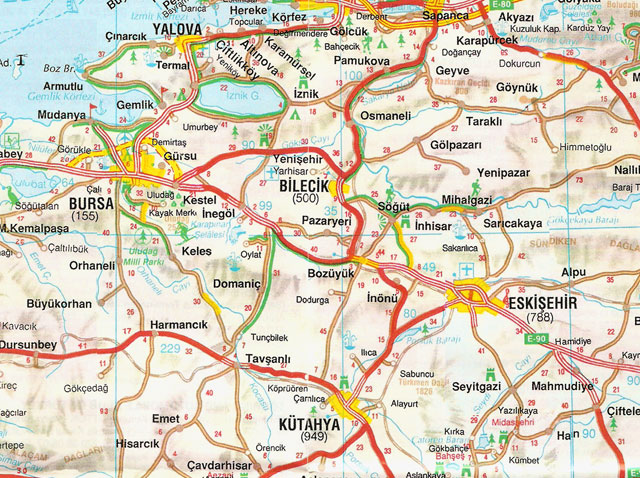
orhaneli kütahya haritası ile ilgili görsel sonucu
This POW was captured near Orhaneli, center left, taken to 
Tavşanlı and then to Kütahya.

From there we were taken to Kütahya and after staying in a cellar full 
of water for 48 hours, we were transferred to a room soiled with blood.  
This room, which at first glance was understood the be the Moslem 
slaughterhouse, was where an artillery captain and a first lieutenant 
were killed, as were Kütahya merchant Ömer Ağazade Cemil, Hasan 
Dedezade Ahmed Hulusi, the former commander of the Simav 
Detachment and a resident of Turgutlu town, Kütahya farm owner 
Hasan and Ketencizade Bezaz Mustafa.  Subsequently, I was taken to 
Bursa and on 4 September I was boarded onto a ship at Mudanya and 
transported amid all sorts of torture to Salonica.  

thessaloniki athens map ile ilgili görsel sonucu
The writer was transported from Mudanya, near Bursa, to
Salonica (Thessaloniki), to Athens and finally to Milos Island

In fact, because of the crowding and torture on the ship, 8 poor souls 
died and their bodies were thrown into the sea.   During the time I was 
held in the Beyaz Kale (White Fortress) in Salonica I saw my co-
religionists die from hunger, thirst and torture.  Hacı Süleyman, from 
Bursa’s Arabayatağı quarter, was beaten to death with a club.  As soon 
as the Greeks learned that we had made complaints to the Allied 
representative in Salonica,  the quickly put us on a ship to Piraeus.  
Those who were shut in the holds below decks and desperate because 
of the crowding, stormed the deck.  At the front of the charge were 
Süleyman Çavuş of Kestanealanı village in İnegöl, Tevfik Çavuş of 
Hayriye village and Nuri Bey of Kirazlı village, all of whom were 
bayonetted.  Süleyman Çavuş’s body was thrown into the sea. 

milos island map ile ilgili görsel sonucu


On 1 December 1923, we were transported to Milos Island.  The 
cruelties inflicted on the prisoners was evident from their appearance.  
They were sent to forced labor from morning till evening, despite 
being broken from hunger and thirst.  Thew were made to work like 
animals and there was no respite from beatings and curses.  Fever 
and typhoid were rampant  and many Moslems died from these 
diseases.  The Greek Government saw no need to taken even the 
slightest measure in this regard.

We confirm the aforementioned’s statements.
Chief of the Commission to Verify Atrocities, Major Abidin
Member: First Lieutenant Abdullah
Member: Osman, Administrative Chief of the Police Directorate

//END of PART XV//