29 Kasım 2018 Perşembe

One Way Village


türkçe links to original Turkish article

(Sözcü Newspaper, 27 November 2018)

bu köyün hem kapısı hem de köprüsü var ile ilgili görsel sonucu
For those who REALLY want to get away from it all...

The village of Irmakyanı in Yusufeli district of Artvin province has
only one way in and one way out.  Access to the village of 152 people
is accomplished only by means of a 50-meter hanging bridge over
the Çoruh River.

bu köyün hem kapısı hem de köprüsü var ile ilgili görsel sonucu
                            Curfew time.

Observers are amazed to see small trucks, minibuses and other vehicles
cross the bridge.  In order to prevent wild animals from entering the
village, there is a steel gate at the bridge's end that is closed by the
last person crossing at the end of the day.  Resident Ethem Somaz
explained that "the bridge's sturdiness is argued about but we need it.
There's no other way to and from the village, so we use it."

artvin haritası ile ilgili görsel sonucu

28 Kasım 2018 Çarşamba

TNT History Mini-Series: Islamic Army of the Caucasus in Dagestan (1918)/Part V

//Ed. Note: A telegram from Turkish Commander
Enver Paşa in Istanbul on 3 October reflected 
the quickening pace of peace talks with the Allies.
In fact, Enver would flee Turkey a week later and
the Mondros Armistice would be signed without
him on 30 October. 

Meanwhile, probably unbeknownst to most of the
IAC/NCC troops, their continued efforts would
ultimately be in vain, as the fighting continued into
November, after the war was over.//

//Ed. Note: TNT will pause here and resume this
epic saga a few days from now.//
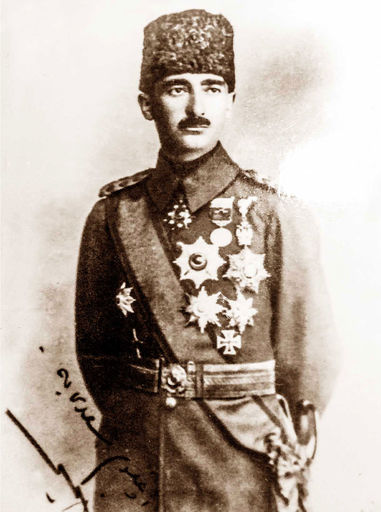


halil paşa 1918 ile ilgili görsel sonucu
Halil Paşa, Commander of the East Armies Group 
(Halil Paşa was Enver Paşa's uncle, although a year
younger.)

In a telegram that arrived at the Islam Army on 2 October, Halil Paşa, 
at the East Armies Group Command, explained that first the 15th 
Division and subsequently the 5th Division would be transported to
Batumi.  Based on this order, Islam Army Commander Nuri Paşa, 
who was in the Karabağ area, ordered that the 15th Division’s 38th
Regiment and a battery  be transported to Haçmaz for onward 
movement to Derbent, and that the 56th Regiment and the Division’s
other resources should remain where they were for the present.  In 
accordance with the previously established schedule, since the 56th
Regiment was transported first, the 38th Regiment was held at 
Bilecari and, for this reason,  the Division’s mobile hospital and 
two provision wings were also sent. This being the case, the troops
transported under the command of the 15th Division Commander 
for Derbent consisted of just the two-battalion Ye56, a cavalry 
company, the Krupp mountain battalion, the ‘kudretli’  mountain 
battalion, the health company and a provision wing. 

Since seizing Derbent with such a weak force would be impossible, 
the 15th Division was forced to halt its forward movement.  Yet, this
operation was essential if the situation in the northern Caucasus was
to be ameliorated.  Because Nuri Paşa wanted the transport to be 
postponed for another period of time, upon his return from Karabağ 
to Baku on the morning of 4 October he ordered that the 38th Regiment
move to Haçmaz and, without disembarking from his train, he went 
straight to the 15 Division HQS at Haçmaz to discuss the attack to be 
made against Derbent.  According to the arrangement sketched out by 
the Main HQS, the 10th Division, presently at Batumi, would return to
Istanbul first, followed by the 15th Division.  So rather than have the 
15th Division wait idly in Batumi, it would be possible for it to engage
in important action here.  Based on an investigation that was made, 
even the 10th Division did no begin transport to Istanbul.  It was 
sufficient that the intention was for the 15th Division troops in the 
vicinity of Derbent to move from there when the transport ships 
departed from  Istanbul.  Based on this consideration, the Islam Army
decided to continue the Derbent operation, under the condition that 
the Division’s transport from Batumi would not be delayed.  But 
because the military situation was not made known to the Army, the 
reason for the transport of these forces to Istanbul was not understood.


 enver nuri 1918 ile ilgili görsel sonucu

(Chief of Staff Enver Paşa, left, IAC Commander 
Nuri Paşa (Enver's younger brother), right)


                                 Situation

Harbiye/3 October 1918

Soon, peace talks, including Germany, will begin and in all 
probability these talks will conclude quickly.  In accordance
 with national principles, our position in the Caucasus must 
be strong and, in particular, the governments in Azerbaijan 
and the northern Caucasus must be reinforced, in order to 
strengthen our legal claims in these peace talks.  For this 
reason, if you leave the 5th Division’s transport aside for now, 
after the 15th Division, the 12th Division is to be transported. 
 I think that, in any event, when the time comes for transport  
the situation will have been completely clarified and decided 
upon.  Keep in touch with us and try to quickly put the local 
Azerbaijani forces in order.  Our forces currently in Azerbaijan
 and the 5th Division will remain in Azerbaijan subsequently 
to put the Azerbaijani military organization in order.  Send a 
large amount of arms and ammunition to Azerbaijan.
Head of the General Staff

              Ferik (Division General)
              Enver

                    To The Islam Army Command

I have included above the telegram I received from the Main
HQS (Istanbul) General Staff.  I request that the transport of the
5th Division be postponed until further notice.  Based on this 
situation, the 9th Caucasus Regiment,  which was sent to Karabağ
 to chasten (the Armenians) and which I had recalled, can 
continue its work.   I also request that the transport of the 15th 
Division commence.  Yusuf İzzet Paşa, the Northern Caucasus 
Commander, is about to arrive in Gimri and I will have him make
a decision about the Caucasus matter.  For now, I request that a 
detachment comprised of an infrantry regiment, half a team of 
cavalry and two cannon be at the ready for the Northern Caucasus,
as per the message from the Main HQS. 

Ali Paşa “Şikhlenski” has identified the cannon at Kars that are 
useable.  Additionally, a sufficient amount of ammunition and 
8,000 riflles will be sent.  The transport of these items is 
dependent of the acquision of sufficient fuel and means of 
transport.  I request that the maximun effort be applied to this 
matter and that as much fuel and empty trains as can be acquired
be sent to Gimri right away. 

4/5 October 1918 East Armies Group Commander
                             Ferik (Division General)
                             Halil

According to these orders, it was decided that the Islam Army’s
15th Division would be transported to Batumi following the 
seizure of Derbent.  It was ordered that a detachment with the 
name Derbent Detachment be established, comprised of  Ye107,
north of Derbent, and a battalion, 42 cavalry and 2 Krupp 
mountain cannon.  Once the area north of Derbent is occupied
by the Ye107th’s battalion, the Division will begin transport to
Batumi.

On 4 October the 15th Division sent Ye56 T2, its batteries and 
health and cavalry companies by train from Haçmaz to Yalama.
In the evening these troops assembled between the Karçağ 
(Kartal) stream and Bilici.  Up to this point there had been no 
contact with the enemy.  Based on the statements of Moslems 
coming from Derbent, on 3 October 300 Russian and Armenian
infantry had come from Petrovsk to Derbent and on 4 October
a transport ship had come to Derbent.

The Division received some additional information to the effect
that the enemy had not  established any defenses so, in order to
allow the enemy to gather additional forces, decided that all 
forces, together with the participation of the 38th Regiment,  
would attack Derbent on 6 October.  The Regimental Commander
was ordered to quickly occupy Derbent on 5 October with a force
comprised of Ye56 T1 and T2, the regiment’s machine gun 
company, a cavalry company and two mountain guns.  The 
regiment had the 1st Battalion advance along both sides of the
 rail line and the 2nd Battalion and the artillerty team followed.


Battle map of Derbent, top. The Caspian Sea
shoreline is in the center of the map.


Without encountering any resistance, the regiment reached the
edge of the Derbent orchards after 8 or 9 o’clock at night.  After 
this point, the rail line’s three tracks started to run into Derbent 
city.  The people in the orchards said that the enemy had fled the 
night before.  And although the troops advanced  to 800 meters 
from the city station, there was still no sign of the enemy.  Later, 
some time after 0145, the enemy, who were hidden in and around
the train wagons at the station began firing, as did an armored 
train that move south from the station.  Our right arm was 
subjected to the fire and since it was comprised of only one 
infantry company  and two machine guns, it halted. The 
regiment, which was unaware of the situation, preferred to 
proceed with caution in light of the broad expanse of Derbent
city.  Nevertheless, the city was entered from the west and the 
enemy was  driven out of the station.  In this way, the regiment 
completely occupied Derbent and overnighted  athe Derbent 
fortress, south of the station.

Today (5 October) two battalions from Y56 fought with a 
detachment made up of 800 infantrymen, 8 machine guns and
two cannons, under the command of Colonel Betran.
Losses for the 56th Regiment: one company commander 
wounded, 25 soldiers dead, 28 soldiers wounded.

On the evening of 5 October, only 2T and 3T of Ye38 came to 
Araplar.  On the morning of 6 October, Division Commander 
Süleyman İzzet Bey gave the necessary command for  a joint 
attack on the city with the participation  of two battalions from
 38 and the Division artillerymen.  As the result of a 
misunderstanding, since more artillerymen than had been 
allocated had come the Division returned a ‘kudretli’ battery 
to the command of the 5th Division at Bilecari, and a group of
 mountain teams to Hacı Kaval for the ‘saliyan’ (permanent?) 
detachment there.   Because two cannon previously at Koba had
 not yet been obtained, the Division had 4 ‘kudretli’  guns and 
6 Krupp mountain guns for the battle on 6 October. 

On the morning of 6 October, two battalions from the 38th 
Regiment and artillerymen departed from Araplar.  There were
still enemy elements at the station.  Batteries were positioned
on the west side of the city and fired effectively at the enemy
elements around the station and at the armored train, which was
trying to approach.  The 38th Regiment was surrounding the 
city from the west and the 56th Regiment seized the station with
an attack.  The city was combed for enemy elements and a 
number of them were taken prisoner.  By noon Derbent was 
completely occupied.

The enemy fled north from the city, pursued by Ye56 on the 
right and Ye38 T2 on the left.  Y338 T3 remained in the city to
 maintain security.  The troops came under intense fire from an 
enemy armored train, and fresh enemy forces that had come from
 Petrovsk via the railway attacked, as well, forcing our troops to
 stop their advance 3 kilometers north of the city, where they  
began to reinforce their position on the rail line. 

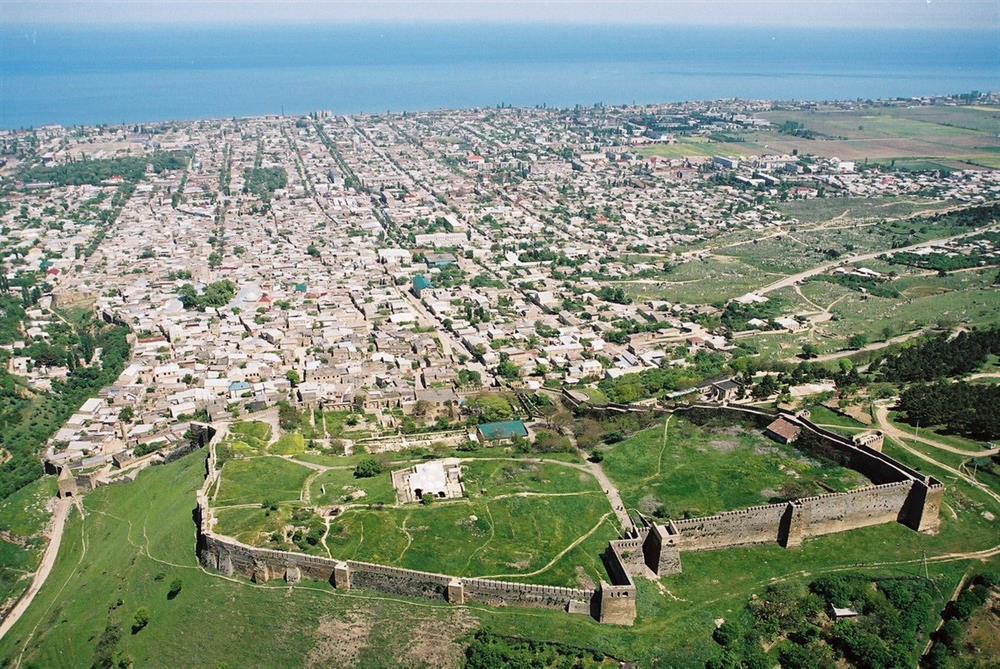
derbent dagistan haritası ile ilgili görsel sonucu
                                         Derbent today

The enemy commander in Derbent, Colonel Bertran, did not 
know that the Turkish troops had come to the Kartal stream and
only learned about the attack on Derbent  on the morning of 5 
October by means of the armored train that he had sent forward.
As the result of the attack by the 56th Regiment, a portion of 
the enemy troops fled on the night of 5/6 October and the 
reinforcement troops sent by ship and rail from Petrovsk could
 not reach Derbent in time.

If the attack  had been conducted on 6 October to ensure the 
participation of the 38th Regiment, as originally planned,  enemy
resistance would have been much greater and we would have 
suffered greater losses.  So thanks to the raid that was made, 
losses were minimized and Derbent was occupied. 

Although Bicherekhov neglected Colonel Beltran, the fact that 
he made many subsequent attacks to stop us and regain the city 
shows how important he thought it was.
                                                            
// End Part V//


TNT History Mini-Series: Islamic Army of the Caucasus in Dagestan (1918)/Part IV

//Ed. Note: In mid-September 1918, after Turkish
forces seized Baku, peripheral problems in Karabağ
with the Armenians led by Zoravar Antranik; with 
enemies around Lenkoran to the south of Baku; and 
with the growing entrenchment of Bicherekhov in 
Derbent and Petrovsk, faced the IAC.// 


The Seizure of Derbent and Petrovsk

general zoravar antranik ile ilgili görsel sonucu
General Zoravar Antranik, center, and his
Armenian fighters.

The substantial Turkish force that laid siege to Baku was comprised 
of the 5th and 15th Divisions, along with two regiments from the 36th 
Division, but after its capture, there was no need for them to remain.  
There was now another more urgent matter that required attention in the
Caucasus.  Antranik, one of the leaders of Armenian irregulars, was 
massacring Moslems around Shusha, Kehdus and Zengehzor, especially
after our success in Baku.  In Shusha, the center of Karabağ, the 
situation of the Moslems was critical and if their situation was not 
addressed urgently they would surely be annihilated. 

Among the population of the northern Caucasus the situation was quite 
critical.  Bicherekhov, who had been in Derbent and Petrovsk for a month 
and a half, organized his troops and after the fall of Baku many Armenian
forces joined him.  Because of the existing situation, no orderly 
government could be established in Dagestan and the head of government,
Mecidçeh Meviyef, had not left Tblisi.  The land of the northern Caucasus
needed to be cleansed of the enemy so that peace and security could be 
restored and an orderly government coul be allowed to operate.   In
addition, it was essential for military reasons that the enemies in Derbent
and Petrovsk be repelled.  It was clear that if Bicherekhov’s force was 
neglected then we would be subjected to an attack on Baku from Derbent.

The defense of Baku, which was in its third and fourth phases, and matter
of military supplies and provisions within Azerbaijan were important 
issues coming on the agenda.  How long the Turkish Army could stay in 
Azerbaijan was in doubt. It was of the utmost importance that the 
Azerbaijanis be able to defend themselves.  Lastly, there remained the 
removal of enemy forces in Lenkoran, located south of the Kura River
delta, on the Caspian Sea coast.  The enemy here showed no sign of 
moving.  In addition, because of Lenkoran’s remoteness from the rail line,
it would be impossible to use the troops to be sent there in any other duty
a month prior to deployment.  And since the sea was controlled by the 
enemy it would be extremely difficult to return these troops, who would
have to be quite strong because of the impossibility of quickly reinforcing
them.  This operation could only be considered if it were to be conducted
as a comprehensive and converging attack on Tehran and Enzeli from 
within Iran.  In the aftermath of the seizure of Baku, the actions to be 
taken and their degrees of importance  have been described above.  With
a telegram on 16 September, the Main HQS  ordered that a mechanized
infrantry regiment with cannon cleanse the northern Caucasus up to the
Terek River; that a detachment immediately move down the Caspian Sea
coast to occupy Enzeli, and that a division remain in the vicinity of Baku.

karabağ map 1918 ile ilgili görsel sonucu

The Armies of the East Group Command wrote to the Main Command 
personally that the 15th Division should be sent to Reşte via the Lenkoran
-Erdbil road; that an infantry regiment from the 5th Caucasus Division, 
along with an artillery battery, should be sent to the northern Caucasus; 
that two regiments of the 36th Division should remain in Baku; and 
ordered  the detachment to be sent to the northern Caucasus to prepare to
go there.  

However, the situation and conditions were not conducive to the 
implementation of these orders, which contained quite a bit of detail.  
The Bicherekhov forces in the northern Caucasus had 5-6,000 
infantrymen,  about 20 cannon and about 100 machine guns.  Just one 
infantry regiment  and a battery were insufficient to retard such an enemy
force.  Additionally,  the order made no mention at all of the Karabağ 
matter.  If Antranik were  ignored the Karabağ Moslems would be 
annihilated and the rail line that ran from Shusha north would be cut off. 
Consequently, a Karabağ operation was essential. 

Antranik was quite strong, although the Armenian government did not 
officially recognize him and expelled him from the army cadre. Never-
theless, he never refrained from his surreptitious resistance.  If three of 
our existing regiments were sent to the north and two to Karabağ, two 
regiments would remain, which would be sufficient for the defense of 
Baku and other operations in Azerbaijan.  There was no force remaining 
for the Lenkoran operation.  It would be impossible to launch attacks 
everywhere.  Launching such attacks without sufficient forces and 
provisions would prolong the conflict and, if unsuccessful, put our 
position in the Caucasus in jeopardy.

Based on these reasons and considerations, the Islam Army Command 
decided to allocate the 56th and 38th Infantry Regiments, a Krupp 
mountain battalion, the 15th Division and its ‘kudretli’ mountain battery,
together with some assistance classes of this Division, for the seizure of 
Derbent and Petrovsk and to allocate a force consisting of the 9th and 
106th Infantry Regiments, Azerbaijani cavalry companies and a Schneider
cannon battalion for an operation against Karabağ, under the command 
of Colonel Cemil Cahid Bey.  The ‘Dehşet’ (terror/awe) movement was 
to be conducted after the resolution of the Karabağ matter.

kafkas islam ordusu ile ilgili görsel sonucu

Besides the Army HQS in Baku and surroundings, there was also the 5th 
Division HQS and its 10th, 13th, 107th Infantry Regiments, a powerful 
mountain battery, one field battery and one ‘öbüs’ (cannon) battery, along
with a ‘kudretli’ mountain battery of the 37th Infantry Regiment there.  
However, since cannon ammunition was in short supply, it was kept for 
the Baku area and provided only for the ‘kudretli’  battery of the
15th division.  The 13th Regiment was to gather in Baku city, while the 
10th and 107th regiments were to assemble at Bilecari.  Because the 
forces allocated for the Dagestan and Karabağ operations were in the 
Baku area they would have to be transported by train as far as the Yehvak
station in order to go to the north and to Karabağ.  Those forces heading 
north would embark at Bilecari station and those destined for Karabağ 
would embark at Pona station.

The Baku-Derbent railway was not in any condition to support large-
scale transport.  Telegraf and telephone lines along the rail line had been 
destroyed, as had been facilities at some stations.  Because the Caspian 
Sea  was under the control of the enemy fleet there was no way to take
precautions on the rail line, which ran along the sea coast.  For these 
reasons, all available railway equipment was allocated for transport to 
Karabağ and this transport was effected between 23-27 September and 
empty  trains were gathered at Bilecari on 30 September for the transport
of the 15th  Division.  Since the Army wanted to display both speed and 
fury in the operation, it wanted the rail line transport capability to 
continue 
without interruption and for the first troops arriving at the gathering point
 to attack within a day or two in order to prevent the enemy from 
implementing countermeasures.  Otherwise, the enemy would have the 
chance to reinforce  its troops from the rear. 

While the Karabağ transport was underway, troops from the 15th Division
gathered at Bilecari and certain shortfalls were remedied. Turkish station 
commanders were appointed for important stations  from Bilecari to 
Yalama, communication lines and tracks were repaired, Russian workers 
on the rail line were provided food and the railway was brought to a 
useable  status.  In addition, the Division sent a scout ahead  to gather 
information about friend and foe.  Based on information received by the
Division on 29 September, it was understood that the railway was ready
to accomplish transport to the Yalama station.

kafkas islam ordusu ile ilgili görsel sonucu


The Division would begin transport based on the sequence listed below 
as of 1 October: Ye65 T1, Ye56 staff officers and Ma.T.Kef, Ye56 T2, 
telegraph team, Division HQS artillery Ye15 staff officers, Krupp 
mountain battalion, ‘kudretli’ mountain battalion, bakers wing; 1st 
heavy provisions wing; health company; Ye38 T, T2, Ye138 staff 
officers, regimental machine gun company T3 (minus one company),
ammunition battalion staff officers, 2nd and 3rd heavy provisions 
wings, Kef 42 cavalry, 3rd Battalion of the 56th Regiment.  These were
all transported on 26 October to Ganja from Bilecari in order to collect
the weapons of Armenian villages south of Ganja.  The 9th Company 
of Ye38 T3 had already been stationed at Zenkelan (Zengilan) from the 
outset.  In this case, the Division was going to move out with 5 infantry 
battalions, 25 machine guns, a cavalry company, 8 Krupp and 8 ‘kudretli’
mountain guns and 4,200 personnel, only half of whom were combatants.

In accordance with the order given by the Army, prior to the attack on 
Derbent, the Division was to gather to the rear of Kartal Suyu (Kargaç 
Suyu) and the first detachment sent to provide cover for the transport 
would be disembarked at Haçmaz and brought forward as far as Kartal 
Suyu (Kargaç Suyu).

The transport began at the appointed time.  An armored train assigned 
to the Division moved first and on it were a mountain artillery team, 
two machine guns and an infantry team.

By midnight on the night of 2/3 October, Ye56 T1, T2, the regimental 
machine gun company, the telegraph team and the Krupp mountain 
battalion had reached the gathering point.  Of these troops, Ye56 T1 
was disembarked at Yalama and provided cover against Derbent. 

derbent dagestan map ile ilgili görsel sonucu
Derbent, far right, lower corner, relative to the North Caucasus.