28 Mayıs 2019 Salı

TNT POW Reports: Turks in Greek Hands (1920-1923)/Part IV

//Ed. Note: In this POW report, the writer first details his
capture by the Greeks near Gediz in the south of today's
Kütahya province (about where the 'T' is in the word 
'Kütahya' on the map below.)  After detention in Gediz,
he was marched from there to Uşak (middle of the map).

He was transported to Izmir and ultimately spent his
captivity on Lefkada Island.  See Part II of this series
for more on Lefkada.//

gediz uşak haritası ile ilgili görsel sonucu

In response to the general message number 13241-869 of the Interior
Ministry, dated 18 April 339 (1923), which was received from the 
Ministry for National Defense, herewith the statement of Second 
Lieutenant Osman Efendi:

On 24 October 336 (1920) at the place called Yongalı Pass where the 
road to Gediz runs through steep slopes on the right and left, we were 
attacked by the Greeks and a battle ensued in which we had the chance 
to respond but I was taken prisoner as the result of a bayonet charge.  
There were about 10 soldiers with me and a few of them were slightly
wounded.  One of my soldiers named İsmail from Mudurnu town was 
wounded in his foot and killed with a bayonet by a Greek guard during 
our transport.  I was transported to Gediz town, where I was made a 
prisoner.  

After staying in the local jail, hungry and uncared for, for about 10 days 
I was made to march to Uşak on foot in a desperate condition.  At Uşak, 
I remained confined for 30 days in a room in a grape juice factory the 
Greeks had turned into a Gendarmerie post,  barefoot and without a cover 
or a bed.  Because when I was taken prisoner they stole all of my clothes.  
I had nothing.  Later, I was transported in a sickly condition to Izmir, 
where I stayed in Balçova for 18 days, sick, uncared for and desperate.  
Next, I was transported to Piraeus, where I stayed in a Number 26 
Hospital for 6 days, after which I was transported with 10 other officers, 
who were in the hospital with me, to Lefkada Island opposite Preveze.  

lefkada corfu map ile ilgili görsel sonucu
The writer's repatriation from Lefkada Island coincided with
the repatriation of POWs from Corfu Island, both of which
are off Greece's west coast. A few of the Turkish POWs 
decided to stay in Greece, surprising the writer and his 
friends.

My life as a  prisoner passed in the fortress on Lefkada Island, otherwise 
known as Agia Mavra.  In the time of Sultan Beyazid, this island was 
taken under our control.  The camp at the fortress, which is known for its 
massive high walls, was allocated for captive officers and soldiers.  There
were 180 officers at the camp. Today, among our prisoners still remaining 
in Greece are Cavalry Second Lieutenant İsmail Hakkı of Dayı village in 
Afyonkarahisar, Bağdadlı Abdüllatif and customs & dues official and 
officer candidate Burhan of Kadıköy, Istanbul, who is the son of Fars Bey.  

They remained in Greece at their own request.   At the beginning of our 
repatriation when we were boarding the ship at Lefkada Island, the neutral 
Swiss officials asked them to board the ship Espriya with us.  But when 
we arrived in Pire, all of a sudden a Greek Gendarmerie motorboat came 
to our ship with a Gendarmerie officer and some soldiers who then took 
the three ashore at Piraeus.  All of us young and honorable fellows were 
outraged that these three had been taken away but subsequently Colonel 
İsmail Hakkı Bey, the senior-ranking officer at the Corfu camp and Major 
Ali Rıza Bey, the Lefkada camp commander, told us not to interfere and 
that the (Turkish) government would punish them appropriately.  So off 
they went and there was no protest or initiative filed about their departure.  

Nevertheless, this matter is well known by all the officers who returned 
from captivity.

During our prison life in the camp on Lefkada Island only Pharmacist 
Captain İbrahim Efendi of Keşan Hospital died.  The reason for his death 
was lack of care and treatment, which was confirmed with a report by a 
Turkish delegation of doctors.
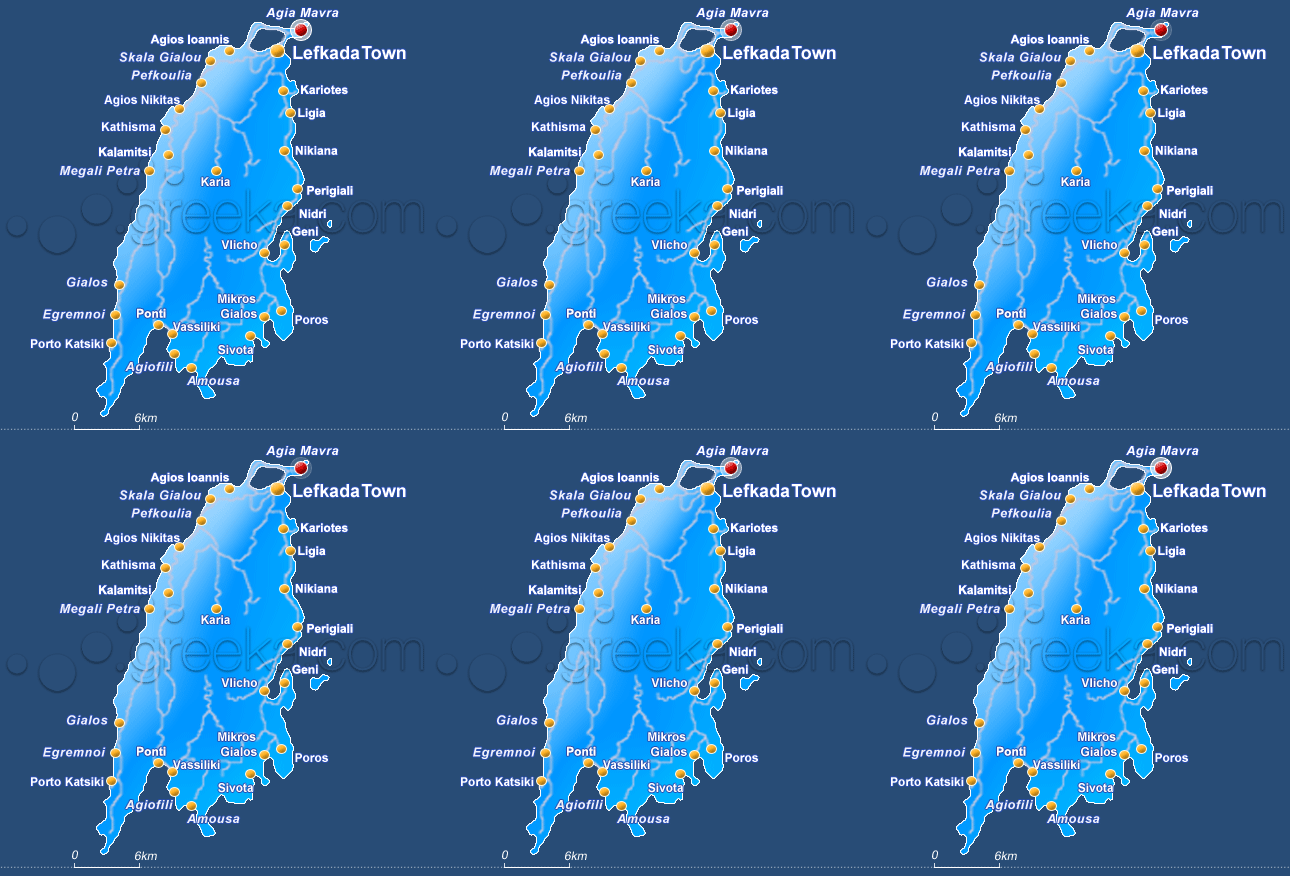
lefkada island fortress map ile ilgili görsel sonucu
The writer was held at the fortress of  Agia Mavra (top of
map) on Lefkada Island.

The entirety of mankind knows that our prisoners were confined under 
conditions of terror and cruelty unrecognized by any civilization.   
Whether at the camp in Athens, the dungeons at Hania, within the high 
walls on Lefkada Island, in the sweltering summer heat at Perveze and 
the equally biting cold of winter locations, where our soldiers were 
sentenced to breaking rocks under dry tents – in short, all of these were 
testimony to the destructive program the Greeks followed.  All of the 
cruelties mentioned above were meted out to all of our countrymen and 
fellow soldiers.

As I mentioned previously, our prison life was spent in the Lefkada 
fortress, which is situated at the end of a canal which connects the Adriatic 
Sea to the Greek Sea, so the fortress is surrounded on three sides by water.  
We had no contact with the outside world.  We lived in desperation one on 
top of another in unhealthy shacks within the fortress, whose size was 
insufficient to hold us.  Every month we were given 440 drahmas, whose 
value is equal to 6-7 banknotes at the market, to take care of all our needs.  
With this money all we could buy was dry bread and cheese.  We never 
saw anything resembling grain.  The fact that all we had were these 440 
drahmas to get everything we needed is the best testimony of our privation.   
Our letters were ripped up at the post office by camp officials and thrown 
into the sea.   We saw them do this despicable thing many times with our 
own eyes.

All of the tragedies and cruelties we were subjected to during our life in 
captivity have been partially presented above.  At the same time, our 
friends have written their own memorandums and these are being 
presented one by one.  When I landed at Izmir, I submitted information 
and details to the proper authorities.

11th Division 127th Regiment 10th Company Second Lieutenant 
Osman Fahri

//END of PART IV//

27 Mayıs 2019 Pazartesi

Pervert Brothers Kidnap Girl Cuz a Woman Would be 'Too Hard'


türkçe links to original Turkish article

(Hürriyet Newspaper, 27 May 2019)

mehmet halil bekmez ile ilgili görsel sonucu
          Maybe it wasn't worth it. Ya think?

In Sancaktepe, Istanbul, an 8-year-old Syrian girl named S.E.M. was
kidnapped on her way to a Koran course by water-selling brothers
Mehmet (45) and Halil (40) Bekmez.  The brothers forced S.E.M.
into a car and took her to a wooded area along the Şile road, where
Mehmet Bekmez sexually assaulted the girl, while Halil Bekmez
waited in the car.

Subsequently, as the brothers were bringing S.E.M. back to the
place where they'd kidnapped her, they hit a truck from the rear at
Sultanbeyli.  There, the young girl told accident onlookers about
her ordeal and the citizens began to beat the brothers, who were
saved from a lynching by the police.  Mehmet Bekmez was taken
into custody and a day later so was Halil Bekmez, who was hiding
at his house.

mehmet halil bekmez ile ilgili görsel sonucu
         The face of an angel (uh!) but there's a devil inside!

Mehmet Bekmez had been convicted of sexual assault in 2000
and only recently got out of prison after an 18-year sentence. In
his own defense he explained that "I can't control my sexual desires.
I figured I couldn't kidnap a woman so I took a girl instead." (!)
Both of the Bekmez brothers were sentenced to 42 years in jail.

sancaktepe sultanbeyli haritası ile ilgili görsel sonucu

TNT Matchbox Diary: A Turkish POW in Russian Prison Camp (1915-1918)/Part LXVII

//Ed. Note: In the oxymoron department, Fuad Bey has
serious servant problems at his Vetluga prison camp -
see bold below.//

turkish pows in russia wwı ile ilgili görsel sonucu
                               Definitely not Vetluga.


12 February 1917 Sunday
The weather is cloudy. Fortunately, it’s not so cold. As soon as I got 
up in the morning there was a noise, a tumult. Apparently, the 
servants are really leaving. Franz came from the Kazarma (main
barracks) together with his friend Joseph. They shook our hands 
when departing and left. Only Dursun remained at the house. 
They were going to take him too but we asked the Commander to 
let him stay (he’s a cook). The servants’ departure has really been 
a blow. I felt very bad. Everyone has to get their own tea in the 
morning. Everyone must do all the duties himself. We even brought 
our own lunches. 

Seven or eight fellows from Malaşova came to visit in the afternoon. 
Most of them came with the aim of having petitions written. It seems 
that by means of these petitions they want to go to other, warmer places. 
In mid-afternoon five servant-soldiers came. Two of them were 
Hungarian and three were Austrian. One of the Austrians had 
previously been a servant and helped during the change of houses. I 
played chess continually at night. We chatted and went to bed.

13 February 1917 Monday
The weather is cloudy. The cold is as it has been. The newspaper is 
full of imaginings and ideas. The problem is always about Turkey. 
The Istanbul and Bosphorus issue is always in the paper. If the
Germans don’t defend us in this peace then this will really constitute 
ingratitude to us for the favors and great sacrifices we’ve made for 
them. But if they do defend us, of course, we’ll remain friends
and allies for a long time. For the Turks’ lives and independence to 
be completely assured, Istanbul and the Bosphorus must not be 
restricted. We must work until this is so (a condition). In any event,
the Russians should give the Caucasus autonomous administration. 
Iran should be completely free and Egypt should be ours or be under 
our protection. Suez should always be ours. Iraq should remain 
completely ours. All our islands should be returned to us and we 
should get enormous war reparations from our enemies…today I 
worked on making a sketch of the house we live in. Tonight
we learned some German from Max.

14 February 1917 Wednesday
The weather is overcast, snow is falling, the wind is blowing. This 
morning Istanbullu Hakkı left here and went to Şarya station for an 
operation. Yet another regrettable incident: Zühdü and Salah had an 
argument in the afternoon. I really got mad at Salah. The problem 
arose because of a joke. Anyway, Salah is ill-mannered, immoral. 
Damn him! Revenge must be taken in any event. The day passed with 
tension. Then in the evening Salah got into an argument with Çerkes 
Mehmet. In mid-afternoon, Çerkes Mehmet and Hikmet had an 
argument. After the evening argument Salah was running his mouth, 
seemingly trying to prove  that he was right and he essentially made us
uncomfortable here in our own room. We talked with Hikmet in the 
evening a bit and I explained all the problems. He agreed. I’m really 
fed up anymore, disgusted. What a scandal! Damn trouble-makers like 
Salah! Because while Turkishness expects benefits from them, on the 
contrary it gets nothing but harm. Wherever he goes, wherever he is he 
sows the seeds of intrigue. The aim and goal of the seed is to pit 
everyone against each other. In truth, I find myself unable to find
the words to describe how low this is and how completely insensitive 
it is to what’s right. We studied German somewhat at night. Tonight 
Halis, Zühdü and I all had headaches. Halis has been suffering since 
yesterday anyway from a cold and a headache. Ah, peace! A person 
gets sick here from worry.

Cabinet Changes in Turkey

15 February 1917 Thursday
The weather is cloudy but there’s no wind. News: in Riga a German 
attack, in Turkey cabinet changes: Prime Minister Talat Paşa Bey, 
Minister of War Enver Paşa, Minister of Marine Cemal Paşa, who was
said in Russian newspapers to have been executed. We walked to the 
riverside after lunch. We learned some German from Max again. 
Today passed  with boredom. Because it’s just so boring to live a life
like this. Ah, our shortcomings in social upbringing and foundations are 
doing bad things to us. Yes, there’s only so much interaction and 
toleration that can be expected in an environment where immorality 
has passed it limit. And anyway, immorality hides everything under a 
curtain of hypocrisy. Can this be broken by some power and reality and 
truth exposed? Anyway…Turkishness needs us now. May God reform 
us. I thought that by going to a different house I would live more 
comfortably and I told this to Halis and Zühdü, for them to come to 
another house with me. Halis agreed but Zühdü didn’t. Perhaps his 
feelings are such that he wants to fight with his enemies until the end.

16 February 1917 Friday
Today is the anniversary of my captivity.Ah, a year ago today what a 
terrible time I was having. Erzurum once again under Russian boots, 
our already weak army in retreat and losing strength day by day, 
Turkishness’s misfortune rising, all are shaking my memory. The 
torments of my miserable past days  and today’s pains were jostling 
my revived existence in a terrible way. I was becoming completely  
dispirited seeing myself at such a time as this under the northern
moons. My hope was darkened. It was as if an iron door was closed in 
front of great Islam. I was thinking at this time that I’ll only find 
happiness in the bosom of black earth. But fortune has also shown  me 
this day, as well, under the burden of a great many torments. Now my 
with from God is to safely return to my homeland and to find my 
parents and brother there.  After achieving that I wish for the strength 
and fortitude to work with all my might for my homeland and 
Turkishness…the misery and calamities I’ve experienced drive me 
always toward work. But to continue depends on health…News: our 
allies are on the offensive on all fronts.  A great many Germans, 
together with officers who will go to school this year have come to 
Turkey and are building roads for lines of transport and 
communication. It is understood that this will enable the Turks to 
prepare for an offensive. The Germans have sunk 102 ships, 60 of 
them English, in eleven days. We went to the bath in Malaşova house 
in the afternoon.  We got cleaned up.  Tahir and Nuri offered us tea. 
When I returned I felt light-headed and went to bed early.

//END of PART LXVII//


26 Mayıs 2019 Pazar

TNT POW Reports: Turks in Greek Hands (1920-1923)/Part III

//Ed. Note: Herewith two more POW reports in this 
continuing TNT series.//


second battle of inönü map ile ilgili görsel sonucu
The Second Battle of İnönü (23-31 March 1921)


The Statement of our  officer:

After the Second Battle of İnönü, I was taken prisoner along with a 
number of others from my company on 10 April 337 (1921).  With me 
was Second Lieutenant Turan Efendi of the 16th Regiment.  I was sent 
via Izmir to Lefke camp, from where, after 6 months, I was sent to 
Corfu Island. 

corfu island map ile ilgili görsel sonucu
                                      Corfu Island (A)

There were no military prisoners remaining on Corfu Island, only 
civilian prisoners. None of the military prisoners died during my time 
as a prisoner.  As for the civilian prisoners, though, 10-15 of them died 
each day.  Since it was forbidden for military prisoners to have any 
contact with civilian prisoners, I don’t know the names of those who 
died. After our army’s victory, with the permission of the Greeks, two 
of our officers were able to collect enough money from among us to 
provide a hot soup each day.  These two officers, taking advantage of 
the more relaxed atmosphere, were also able to get a valid register list 
of those prisoners who died and those who are still alive.  These two 
fellows were Captain Hasan Tahsin Efendi of Istanbul and Second 
Lieutenant Mahmud Muhtar Efendi of Ödemiş.  Captain Tahsin Efendi 
has a document of proof, with the Corfu Governor’s signature on it, of 
the Governor’s confession that the prisoners died of hunger.  Captain 
Tahsin Efendi turned over this document to the government upon our 
return to Izmir. During captivity, personal and despotic treatment was 
meted out to both we military prisoners and the poor civilian prisoners 
continually.  Beatings, confinement and degradation were everyday 
occurrences.  The civilian prisoners, in particular, were confined in 
stone fortresses.  Their rooms were made of marble.  They had next to 
nothing on their bodies and those with undershorts and a shirt 
considered themselves lucky.   They were all naked, enough to make 
one think of the Middle Ages.  For food the Greek government gave 
them 100 ‘dirhem’ (one ‘dirhem’ is 1/400th of an okka, which is 2.8 lbs.) 
of bread and 30 ‘santim’ in Greek money. This was the lifestyle we had 
while in Greece.

21 May 39 (1923)
4th Division 12th Regiment 6th Company
Second Lieutenant Sıddiki


----------------------------------------------------------------------------------

The statement of our officer:

First of all, since it is related to our arrest and incarceration, we will 
make propaganda in favor of Turkey and the National Movement.  
Above all, with the goal of killing the ideal of a nation, the Greeks, in
addition to the policy of terror that they implemented in our occupied 
country, for the past two years they have compiled a register and 
prevented those named on this list from leaving the country.  

So every 24 hours they called the roll. On 12 August 38 (1922), we 
were concerned about whether or not we would remain in the country.  
But in the early morning that day we were assembled at the Gendarmerie 
Command and we were transported to Izmir in custody.  In Izmir we 
were deliverd to the Tepecik prisoner camp, where we stayed for 12 days, 
before being transported to Midilli Island.  During the trip, we prisoners 
had to sit one on top of the other because there was so much military 
material being carried on our ship.  Fortunately, it was a short trip and 
nothing untoward happened.

midilli island map ile ilgili görsel sonucu
                      Midilli (Lesvos) Island (red dot)

We we going to shore at Midilli in barges, but the naval captain from 
the Midilli port authority who was in charge of the barges sat in the spot 
on the barge where people would board.  When prisoners would try to 
board he would violently push them aside like sacks and he aimed this 
treatment, in particular, toward the civilian prisoners, including the 
corpulent members of the Moslem clergy, who he’d push even more 
forcefully for a laugh and to denigrate them.   Most certainly, there was 
not limit to their abusive language.  At the camp we set up at a place 
called Giradifu on Midilli, their first cruelty was to leave us hungry.  
When they would give 8 people one bread they would take note of their 
own nation’s refugees coming to Midilli and resent us for taking some 
of the resources.  Only reluctantly did they give us some little amounts 
of bread.

In addition to keeping us hungry, for three days, thirsty and under the hot 
sun, they harassed us by making us march 20 kilometers with goods and 
tents on our backs.  One day, one of the prisoners ran away so they 
rounded up 30 civilian prisoners and us, as well, and asserted that we had 
facilitated the escape.  They demanded to know where the fugitive was 
within 30 minutes and they threatened to shoot us if we didn’t provide 
this information.   Next, they took all our money and put us in the 
basement of the Midilli prison, which was filled with all sorts of transport 
materials.   We were confined there for 10 days, after which we left this 
fetid place and in despair and duress we were transported to Athens, where 
we were put in the prisoner battalion.  

We boarded the ship ‘Matiyus’ to go to Athens and were put in the ship’s 
hold, exceeding its capacity by 300 people.  The hatches above us were 
shut.  To increase our thirstyness, in particular, they didn’t give us any 
water after we’d eaten the canned meat they gave us, claiming they had 
no water to give us.  The prisoners became agitated by the lack of water 
and the Greek officers and soldiers pulled out their revolvers to threaten 
us.  Finally, as the hold full of 800 people began to go after one another, 
they gave us 7 gas cans of water to appease both us and themselves.

This situation continued for 3 days and 3 nights.  Many people in the 
hold where I was passed out from thirst and were taken out on stretchers, 
in the face of the fury of the other prisoners. In Athens, we were left in 
the open at Gudi, where there were many covered cannon depots. While 
there, a Greek cavalryman wanted to show off so he bragged to us that 
around Uşak 500 retreating Turkish prisoners were put to the sword.  

Only 140 of these Turks made it to Izmir and another 150 prisoner 
soldiers were kept in a number of villages around Uşak.  Later, when we 
were sent to the Losya camp, where there were civilian prisoners, a 
fellow named Hristo, a sergeant who was drafted into the army while he 
was teaching school, confirmed the details of this horrific incident.  
Despite the fact that the aforementioned camp had been there for a long 
time,  the prisoners were put under a portable tent set up next to the 
shacks where the Greek guards slept.  Most of them were suffering from 
dysentery and tuberculosis.  The camp doctor didn’t care for the sick and 
in order to trick those who were near death he would register them in the 
hospital.  But whenever a patient would die like this, the same thing 
would happen the next day and another ill Turk would die.   And another 
horrific problem was itching disease. 

In addition to the health threats of living in filth like this, the prisoners 
were beaten by the Greek soldiers and tortured on pretexts to the point 
that  their heads were on the verge of exploding and their arms and legs 
on the verge of breaking.  One day a Greek cavalryman fired his gun at a 
place where the prisoners were gathered and we saw that one of the 
prisoners was wounded from this.  The injured man was taken to the 
hospital 3 days later but we don’t know what happened to him because 
we escaped at this time.

sakız island map ile ilgili görsel sonucu
After escaping from the Losya POW camp in Athens, the
writer fled to Chios (Sakız) Island but was recaptured.

The Greeks tried to destroy the religion of the thousands of Turkish sons 
intheir hands.  Because of these totally inhumane actions we escaped 
from Athens on 5 November 338 (1922), along with 7 fellows from 
Seferihisar.  But we were recaptured unfortunately on Sakız Island.  
After being beaten and thrown in the dungeons of the prison there, 
left hungry and uncared for, we were told by everyone from the top 
commander to the lowest private that we had escaped because we were 
spies and that our punishment would be death by firing squad.  They 
scared us in this way each day, trying to make us sick and die. But these 
careless fellows didn’t reckon with the Turk’s determination.  They took 
our money and then gave it to us bit by bit.  The prison guard took the 
money we gave him to let us have a little air.  Some 1,500 franks that was 
taken from us by the Sakız central command was stolen. Subsequent 
appeals we made on this matter fruitless and we did not recover our 
money.  In summary, the filth and torture we suffered cost the lives of 
thousands of Turkish prisoners.

Halilzade  Hüseyin Fehmi                    

Veterinarian Captain Ekrem


Mars 2020 Alaturka: 2 Million Turks Invade


türkçe links to original Turkish article

(Hürriyet Newspaper, 26 May 2019)


umut yıldız mars 2020 ile ilgili görsel sonucu
                         Also valid on any THY flight...

Out of the 4 million people who have signed up with NASA to have
their names sent to Mars in 2020, nearly half of them are Turks (!).
NASA's public relations department was so surprised by this that they
reached out to NASA employee Dr. Umut Yıldız (whose surname
means 'star' (!)) for an explanation.

Dr. Yıldız, an astrophysicist, said that "NASA's PR dept. called me,
amazed at the overwhelming response from Turkey.  I told them
that the sign-up exploded on social media in Turkey and from there to
Turkish TV, internet sites and newspapers. Whole families signed up
and there were special Mars activities in schools."


umut yıldız mars 2020 ile ilgili görsel sonucu
Dr. Yıldız wears some good advice for his fellow travelers.

With regard to the 2020 Mars project, Dr. Yıldız explained that
"the Mars 2020 project is NASA's next Mars robot project. It's
essentially a copy of the Curiosity robot that has worked on Mars for
7 years, collecting rocks and soil for geologic research.  Mars 2020
will be looking for signs of current or past life on Mars.  Millions of
names will be written on the robot."

türkiye mars haritası ile ilgili görsel sonucu
                                  Mars invasion alaturka.